-
Whatsapp +86 13526654721
-
Email: sales@carmatrolls.com
-
Address: AUX Industrial Park, Shangjie District, Zhengzhou City, Henan Province, China
-
Whatsapp +86 13526654721
-
Email: sales@carmatrolls.com
-
Address: AUX Industrial Park, Shangjie District, Zhengzhou City, Henan Province, China

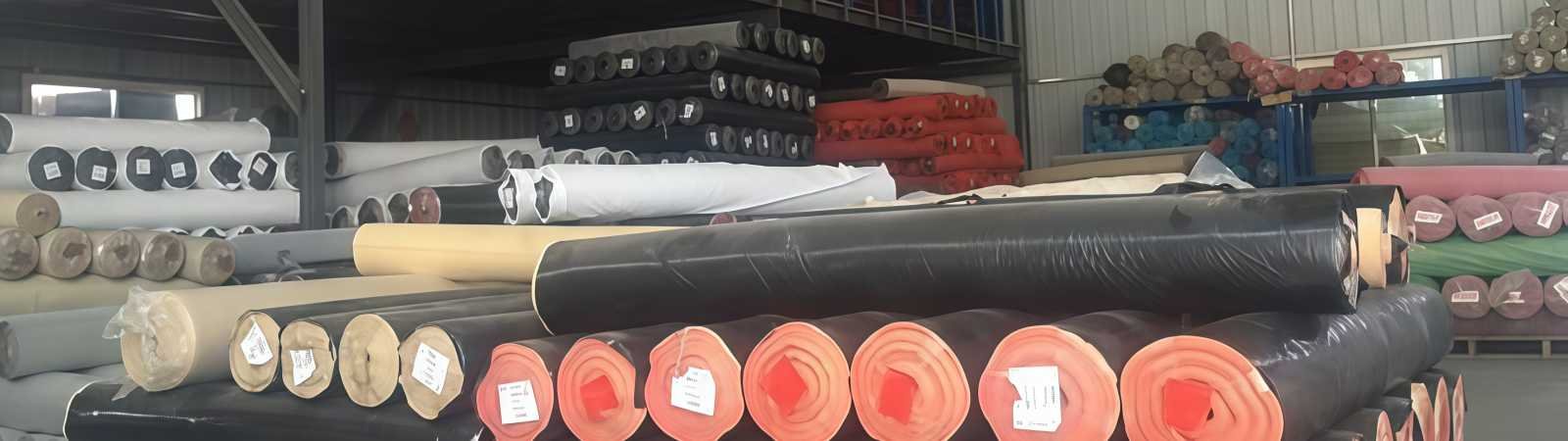
Why You Need a CNC Cutting Machine for Custom Car Mats
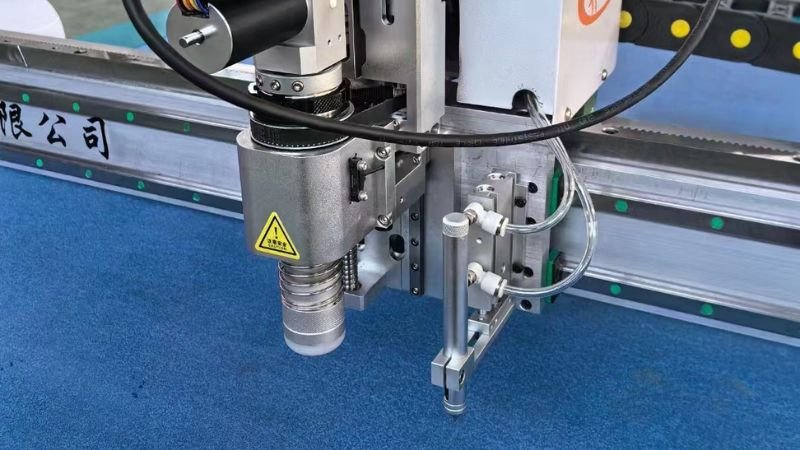
Why is a CNC cutting machine considered an essential investment for modern custom car mat manufacturing businesses?
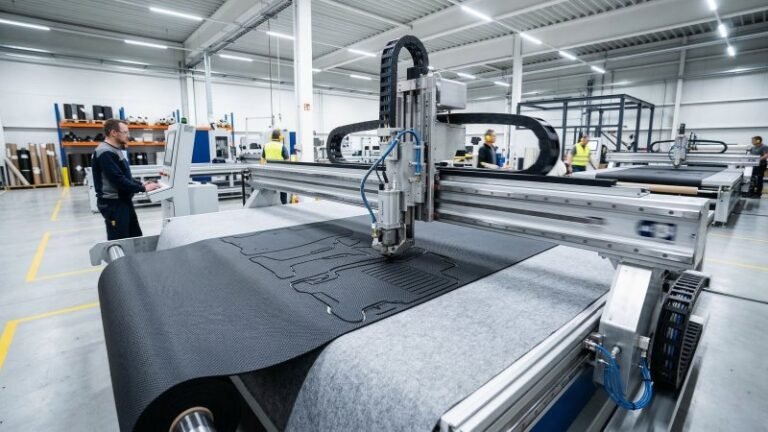
A CNC cutting machine is indispensable for custom car mat production because it eliminates the high recurring costs of physical dies, maximizes material utilization through automated nesting algorithms, and ensures superior edge quality without the toxic fumes associated with laser cutting. By digitizing production, manufacturers can instantly adapt to new vehicle models and produce custom orders efficiently, significantly increasing profitability and operational scalability.
Eliminating the Recurring Costs of Physical Dies
One of the most immediate financial impacts of adopting CNC technology is the removal of tooling expenses.
A CNC cutting machine eliminates the financial burden of purchasing and maintaining physical molds by utilizing digital CAD files to guide the cutting tool. This digital approach removes the recurring capital expenditure required for manufacturing steel rule dies for every vehicle model, while simultaneously reclaiming valuable warehouse space previously needed for die storage.
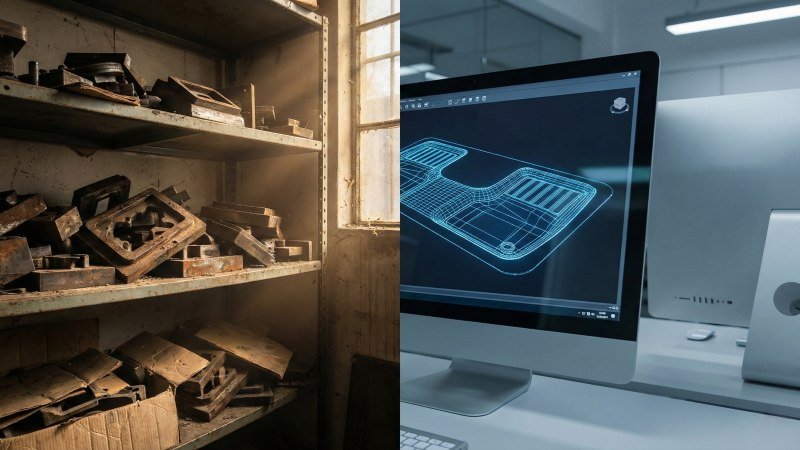
Transitioning from rigid die cutting to digital CAD files
In traditional car mat manufacturing, you must purchase a specific tool, known as a steel rule die, for every single car model. This creates a massive financial barrier. For example, a set of dies for a standard sedan (driver, passenger, and rear mats) can cost between $300 and $800, depending on complexity and steel prices. If you offer mats for 500 different vehicle models, your investment in “dead stock” tooling sits in the hundreds of thousands of dollars.
A CNC cutting machine replaces this hardware with software. Instead of a heavy metal mold, the machine reads a digital vector file (usually in .DXF or .PLT format). This transition fundamentally changes your asset management. You no longer have money tied up in rusting metal sitting on a shelf.
Consider the ongoing maintenance of physical tools. Over time, the blades on a steel die become dull. You must then pay to sharpen them or replace the rubber ejection foam. In contrast, a CNC machine uses a single oscillating blade. When this blade dulls, you replace it for a few dollars, rather than refurbishing a heavy tool.
Comparison: Physical Dies vs. Digital Files
| Feature | Traditional Steel Rule Die | CNC Digital File |
|---|---|---|
| Initial Cost | High (Recurring for every new car model) | Zero (Created internally or one-time scan fee) |
| Storage Requirement | Massive physical shelving (Warehouse space) | Hard Drive / Cloud Storage |
| Maintenance | Re-knifing, foam replacement, rust prevention | None (Files do not degrade) |
| Modification | Impossible (Must scrap and buy a new die) | Instant (Edit lines in software) |
(Note: While digital files do not degrade, the lifespan of the CNC oscillating blade itself will vary based on the abrasiveness of backing materials like anti-slip burrs.)
Furthermore, mistakes in the die-making process are costly. If a die manufacturer creates a mold that is 5mm too wide for a center console, that die is essentially scrap metal. You must order a new one and wait. With a digital workflow, if a prototype is slightly off, the operator simply adjusts the node in the CAD software. The correction takes seconds.
Instant production readiness for new vehicle model releases
Speed is a critical competitive advantage in the aftermarket automotive industry. When a car manufacturer releases a new vehicle, like the latest Toyota RAV4 or Ford F-150, the demand for custom mats peaks immediately.
If you rely on physical dies, you face a significant “time-to-market” lag. You must wait for the car to be available, take measurements, send the data to a die maker, wait for the heavy tool to be fabricated, and then ship it to your facility. This process often takes two to four weeks. During this time, you cannot fulfill orders.
A CNC cutting machine removes this waiting period. The workflow shifts entirely to data acquisition. As soon as you obtain the floor data—whether through a handheld 3D scanner or a purchased database—you are ready to cut.
The Workflow Difference:
- Die Cutting: Measure → Order Tooling → Wait (2-4 Weeks) → Receive Tool → Test → Production.
- CNC Cutting: Measure → Import Data → Start Production (Same Day).
This capability allows you to sell products for a new car model effectively on the day of its release. Think of this like a machine shop switching from a fixed drill jig to a programmable CNC mill. With the jig, you can only drill holes where the metal plate allows; if the design changes, the jig is useless. With the CNC mill, you simply update the coordinates. In the car mat business, this agility means you can say “yes” to new models while your competitors are still waiting for their molds to arrive.
Maximizing Raw Material Profits with Auto Nesting
Material costs often represent the largest ongoing expense in mat production. How does automation address this?
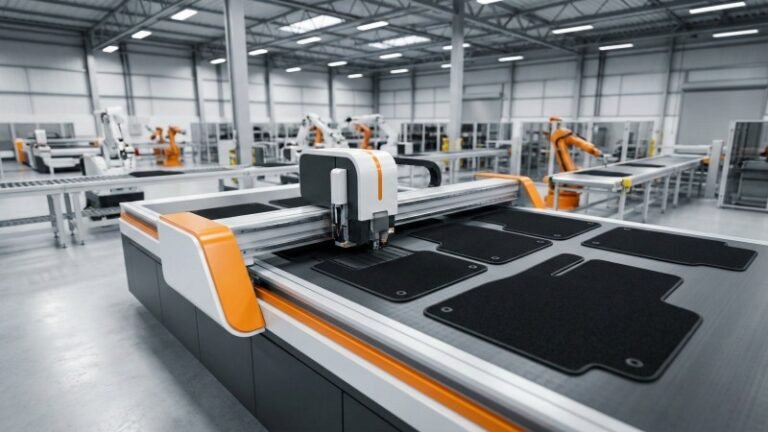
Auto nesting maximizes raw material profits by using advanced algorithms to calculate the most efficient layout of car mat patterns on a material roll. This technology rotates and interlocks shapes far better than human operators, reducing scrap rates and ensuring that you get the maximum number of saleable products from every yard of fabric purchased.
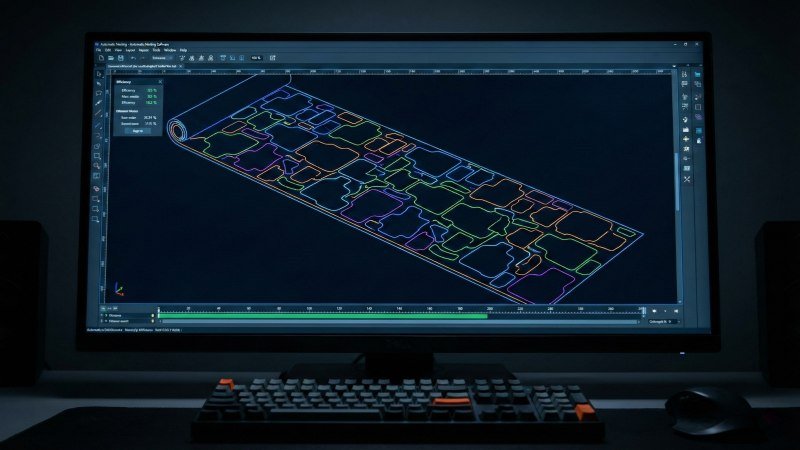
Reducing material waste by over 15 percent with intelligent algorithms
In manual cutting operations, the operator must guess the best way to arrange the patterns on the fabric. This process is inherently inefficient. A human worker will typically leave large safety gaps between pieces to avoid errors. Consequently, this results in “webs” of wasted material that end up in the trash.
CNC nesting software eliminates this guesswork. The computer analyzes the shape of the driver, passenger, and rear mats. It then calculates thousands of potential layouts in seconds. The software fits the pieces together tightly, often utilizing the space inside the curve of one mat to place a smaller corner of another.
Key capabilities of algorithmic nesting include:
- 360-Degree Rotation: The software spins patterns to find the perfect fit.
- Common Line Cutting: It aligns two straight edges so the machine only needs to cut once for two parts.
- Gap Control: It maintains a consistent, minimal distance between parts suitable for the specific material thickness.
The concept here is identical to a sheet metal fabrication workshop using a CNC plasma cutter. Instead of shearing linear strips and wasting the ends, the machine nests shapes organically across the entire sheet. By moving from manual layout to digital nesting, custom car mat manufacturing facilities typically see material utilization rates jump from roughly 70% to over 85%.
Annual Cost Savings Example:
| Metric | Manual Layout | Auto Nesting (CNC) |
|---|---|---|
| Material Utilization | 70% | 85% |
| Waste Percentage | 30% | 15% |
| Material Usage per Set | 4.2 meters | 3.5 meters |
| Savings per 1,000 Sets | 0 meters | 700 meters |
Optimized cutting paths for expensive XPE and leather fabrics
When working with high-cost materials like premium synthetic leather or multi-layer XPE and leather fabrics, waste is expensive. These materials often cost three to four times more than standard carpet. Therefore, errors in layout are financially painful.
Nesting software does more than just squeeze parts together. It optimizes the cutting path. This means it determines the exact sequence in which the machine cuts the lines. If a machine cuts a large piece randomly, the material might shift as tension is released. This ruins the cut. Intelligent pathing ensures the machine cuts internal holes first and outer perimeters last. This maintains vacuum suction and material stability.
For car mats, you often deal with directional materials. Some synthetic leathers have a visual grain or a specific nap. You cannot simply rotate a piece 90 degrees, or it will look different from the other mats in the set. CNC software allows you to set grain constraints. You can tell the machine, “You must keep the driver’s mat aligned with the grain, but you can rotate the hidden reinforcement pads freely.”
Furthermore, XPE material is thick and sold in rolls of varying widths. If a supplier sends a roll that is 1.55 meters wide instead of the standard 1.6 meters, a manual template might not fit. The CNC software instantly recalculates the nest for the narrower width, preventing the need to scrap an entire roll due to a minor supplier variance.
Overcoming Labor Shortages and Skill Dependencies
A major operational bottleneck for growing businesses is the reliance on manual labor.
A CNC cutting machine mitigates labor shortages by automating the complex cutting process, allowing a single operator to perform the work of four to six manual laborers. This technology reduces reliance on highly skilled craftsmen, as the machine executes pre-programmed digital instructions with unwavering precision, independent of the operator’s manual dexterity or experience level.
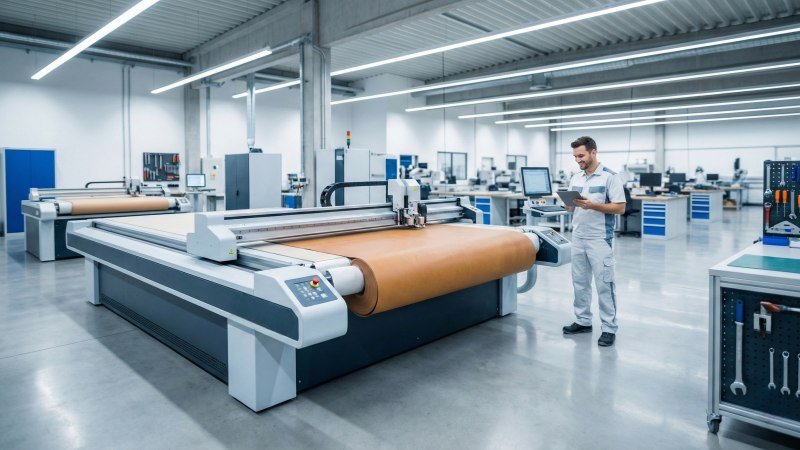
Replacing multiple manual workers with a single automated unit
Finding reliable workers is difficult; finding workers willing to perform physically demanding manual cutting tasks is even harder. In a traditional workshop, increasing production volume means hiring more people to physically handle shears, rotary cutters, or heavy hydraulic presses.
A CNC machine changes this equation. It shifts the workload from muscle to motor. A standard oscillating knife cutting machine operates at high speeds, often reaching 1000mm/s to 1500mm/s (depending on material thickness). Because the machine moves so fast, it drastically outperforms manual labor. One staff member is only needed to load the material roll and unload the finished pieces.
Production Output Comparison
| Metric | Manual Labor (1 Worker) | CNC Machine (1 Operator) |
|---|---|---|
| Cutting Tool | Hand shears / Utility Knife | Oscillating Knife Head |
| Average Sets Per Hour | 3 – 5 sets | 20 – 30 sets |
| Physical Effort | High (Fatigue sets in quickly) | Low (Mainly supervision) |
| Scalability | Linear (Hire more people to grow) | Exponential (Add shifts, not people) |
This is similar to the evolution in the textile industry from hand-cutting patterns to using automated spreading and cutting machines. The CNC machine acts as an automated system that runs itself, allowing business owners to accept large orders without panicking about hiring temporary staff. You can double your output simply by running the machine for longer hours.
Ensuring production consistency regardless of operator fatigue
Manual cutting relies heavily on the steady hand of the worker. A “master cutter” with ten years of experience can cut a perfect curve. However, a new hire will likely struggle, leaving jagged edges or deviating from the line. This creates a dependency on specific, highly skilled employees. If your best cutter calls in sick, your production quality drops immediately.
Human operators also suffer from fatigue. A worker cuts perfectly at 9:00 AM, but by 4:00 PM, their arms are tired and focus drops. A slip of the knife can ruin a car mat or cause an injury.
CNC machines do not get tired. They do not have “bad days.” The machine follows the digital vector line within a tolerance of 0.1mm. The first car mat cut in the morning looks exactly the same as the hundredth mat cut in the evening.
Impact on Quality Control:
- Standardization: Every curve and corner is identical. This is crucial for branding.
- Safety: The operator stays away from the blade during cutting.
- Skill Gap Reduction: You no longer need to train someone for months on how to hold a knife. You only need to train them on how to operate the software interface.
Delivering Superior Finish Quality Over Laser Alternatives
Why is a digital knife cutter considered superior to a laser machine for finishing car mats?
CNC knife cutters utilize a physical blade to slice through materials without generating heat, thereby preventing the burnt edges, discoloration, and toxic fumes caused by laser machines. This “cold cutting” process preserves the structural integrity and visual appeal of synthetic leathers and foams, ensuring a premium finish that meets high automotive interior standards.
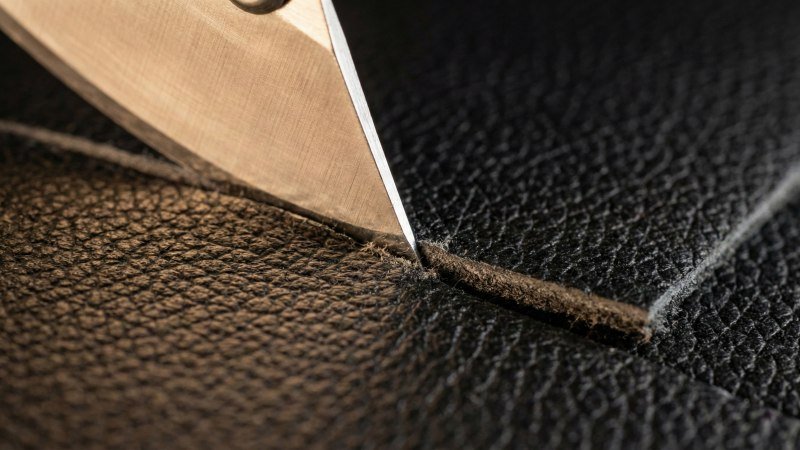
Avoiding burnt edges and unpleasant odors on synthetic materials
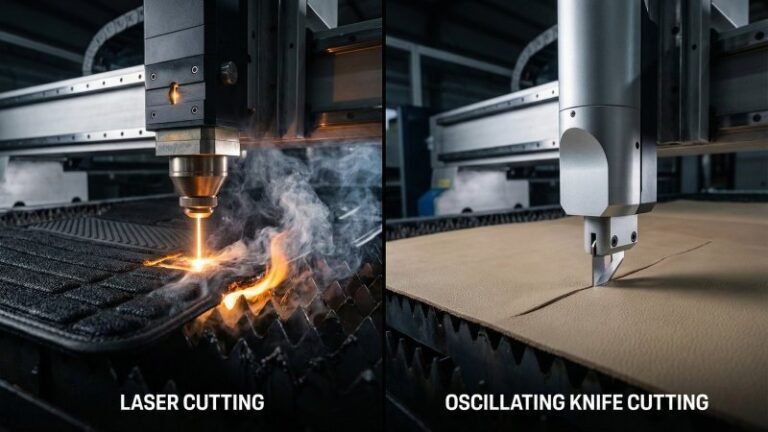
Many car mat manufacturers initially consider laser cutting because it seems high-tech. However, lasers work by burning through material with a high-energy beam. This thermal process causes significant quality issues when applied to common car mat materials like PVC, XPE foam, or synthetic PU leather.
When a laser cuts these synthetic materials, it leaves a charred, black edge known as carbonization. If you are producing beige, red, or gray mats, the laser leaves an ugly yellow or brown scorch mark along the cut line. This damage is permanent and ruins the aesthetic of a luxury product.
Furthermore, burning plastic creates smoke and toxic fumes. Car mats are installed in a small, enclosed space: the vehicle cabin. Laser-cut mats often retain a strong smell of burnt plastic. Customers will notice this odor immediately when they open their car doors.
In contrast, a CNC oscillating knife uses a “cold cutting” method. A sharp, vibrating blade physically separates the material. There is no heat involved.
Comparison of Cutting Methods on Synthetic Material
| Feature | Laser Cutting | CNC Oscillating Knife |
|---|---|---|
| Edge Appearance | Charred, blackened, or yellowed | Clean, original material color |
| Edge Texture | Hard, brittle, or melted beads | Soft and smooth |
| Odor | Strong smell of burnt plastic | No odor |
| Material Safety | Releases fumes (requires heavy ventilation) | No hazardous emissions |
Creating clean vertical cuts essential for precise stitching
The quality of the cut edge directly affects the next step in production: sewing. Most custom car mats require an edge binding or stitching to look finished. To sew this binding on correctly, the edge of the mat must be perfectly vertical (90 degrees).
Laser beams have a specific focal point. As the beam penetrates thick materials (car mats often range from 10mm to 20mm), it loses focus. This creates a “V” shape or a tapered edge rather than a straight line.
A tapered edge creates a problem for the sewing machine operator. When they try to wrap the leather binding around the edge, it does not sit flat. The binding might slip off, or the stitching line might look wavy. Additionally, laser-cut edges are often hardened by the heat (melted plastic), which can cause sewing needles to break frequently or lead to skipped stitches.
A CNC machine uses a rigid steel blade that plunges straight down. It maintains a perfect vertical edge regardless of the material’s thickness. This ensures that the sewing operator has a uniform surface to work with, resulting in smooth, professional stitching.
Unlocking True Customization Capabilities
The ability to handle bespoke orders without disrupting the production line is what separates modern workshops from traditional factories.
CNC cutting machines unlock true customization by integrating directly with 3D scanning data, enabling a seamless “scan-to-cut” workflow. This digital process eliminates physical tooling changes, allowing manufacturers to profitably produce single, bespoke orders for rare or modified vehicles with zero setup downtime between different jobs.
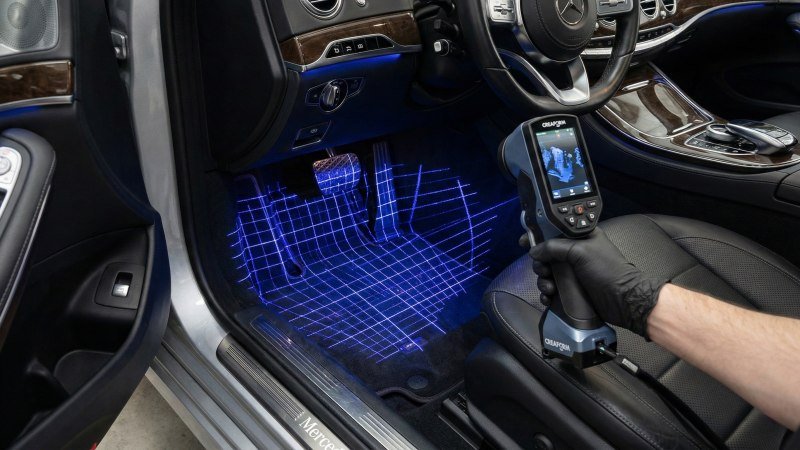
Workflow integration from 3D scanning to immediate cutting
The modern automotive aftermarket relies on data. To make a mat that fits perfectly, you need an exact replica of the vehicle’s floor. In the past, this meant crawling into a car with cardboard, scissors, and a marker to make a physical template. This method was slow and prone to human error.
Today, the industry standard is 3D scanning. A technician uses a handheld laser scanner to capture the floor’s geometry in minutes. This creates a dense point cloud of data. The CNC machine is the final step in this digital chain.
The Integrated Data Pipeline:
- Scan: Capture the floor topology (humps, pedals, seat rails).
- Process: Convert the 3D scan into a flattened 2D drawing (DXF/PLT format) using CAD software.
- Cut: Send the file to the CNC machine for immediate production.
This workflow is comparable to reverse engineering in precision machining. Just as a machinist scans a broken part to mill a new one, a mat manufacturer scans a floor to cut a matching cover. The digital file is precise, capturing complex contours that a cardboard template often misses. Crucially, this integration removes the disconnect between the design room and the production floor.
Efficiently processing low volume and bespoke orders without setup downtime
In traditional manufacturing, “Batch Size One” is a nightmare. If a customer wants a custom mat for a vintage 1960s classic car, or a modified van with aftermarket subwoofers, a die-cutting factory cannot help them. Making a single steel die for one order costs more than the profit from the sale.
CNC technology eliminates the concept of “Minimum Order Quantity” (MOQ) for production. Because the “tool” is just a digital file, the cost to switch from cutting 100 sets of Honda Civic mats to 1 set of custom Ferrari mats is zero.
Setup Time Comparison: Die Cutting vs. CNC
| Action | Hydraulic Die Cutter | CNC Knife Cutter |
|---|---|---|
| Change Job | Stop machine, unbolt heavy die, forklift new die, bolt on, align. | Click “Open File” on screen. |
| Setup Time | 20 – 45 Minutes | 5 – 10 Seconds |
| Economic Viability | Only profitable for batches > 50 sets | Profitable for 1 set |
For example, many modern CNC machines feature a barcode scanning system. The operator can print an order sheet with a barcode. When they scan the barcode at the machine, the computer automatically loads the correct cutting file for that specific customer. This means you can process fifty different unique orders in a row without ever stopping the machine to adjust settings. This fluidity turns a custom job shop into a high-speed production line.
Conclusion
Investing in a CNC cutting machine is not merely a purchase of new equipment; it is a strategic shift towards a leaner, more profitable production model. By eliminating the reliance on physical dies, manufacturers can reduce overhead costs and respond to market trends instantly. The combination of automated nesting and consistent mechanical precision drastically lowers material waste and reliance on manual labor, ensuring a rapid return on investment.
Ultimately, for businesses in the competitive automotive aftermarket, the ability to deliver high-quality, custom-fit car mats without the limitations of traditional tooling is the key to scaling operations. Whether you are producing mass-market sets or bespoke luxury interiors, a CNC cutting machine provides the necessary agility and efficiency to lead the market.