-
Whatsapp +86 13526654721
-
Email: sales@carmatrolls.com
-
Address: AUX Industrial Park, Shangjie District, Zhengzhou City, Henan Province, China
-
Whatsapp +86 13526654721
-
Email: sales@carmatrolls.com
-
Address: AUX Industrial Park, Shangjie District, Zhengzhou City, Henan Province, China

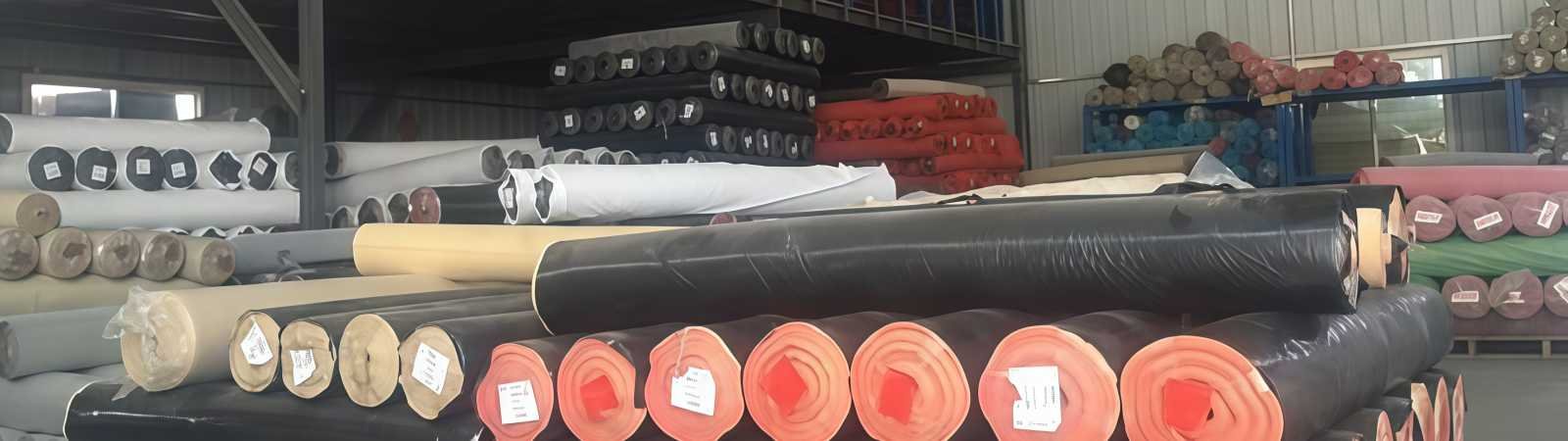
Vacuum Forming vs. Compression Molding: Car Mat Process Comparison
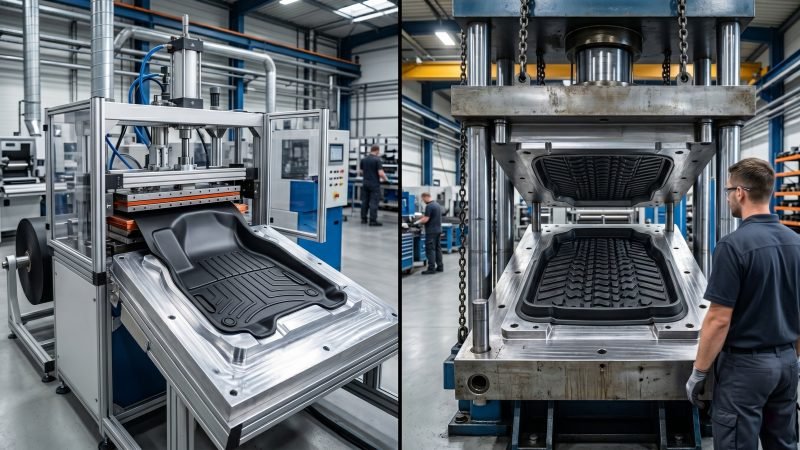
When deciding between vacuum forming and compression molding for car mat production, which manufacturing process offers the best balance of cost, quality, and speed for your business?
Vacuum forming provides a rapid, cost-effective solution ideal for fast-paced aftermarket sales by shaping extruded thermoplastic sheets over affordable aluminum molds. On the flip side, compression molding delivers superior durability, perfectly uniform thickness, and highly detailed textures by pressing pre-plasticized materials or rubber blanks in heavy-duty steel molds, making it the optimal choice for premium OEM applications.
Process Mechanics and Production Efficiency
How exactly do these two manufacturing methods operate on the factory floor to build a car mat, and which one is faster?
Vacuum forming pulls a heated, flat thermoplastic sheet over a single mold using negative air pressure. The result? A very fast and highly automated production cycle. Compression molding, however, squeezes a pre-heated polymer mass between two heated mold halves using extreme hydraulic force. That means it requires a longer processing time, but it skips the continuous sheet extrusion step entirely.
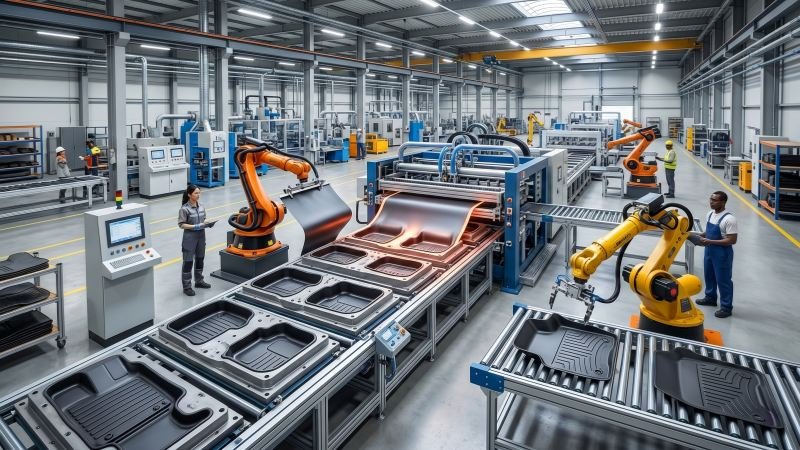
Thermoplastic Sheet Forming vs. Melt Pressing Techniques
To truly understand these methods, we must look at how the raw material transforms. Vacuum forming relies on a secondary raw material. First, manufacturers must use an extrusion machine to turn raw plastic pellets into a continuous flat sheet. Next, the factory feeds this sheet into the thermoforming machine. The machine clamps the sheet, heats it until pliable, and then a vacuum sucks the material tightly against the mold cavity.
Think of vacuum forming like shaping a large dashboard panel—a flat plastic sheet is simply stretched over a mold form.
Now, look at compression molding. It utilizes a dense, prepared block of material. Ever try to force cold, stiff material into a complex mold cavity? It doesn’t work. That’s why operators place a pre-plasticized, high-temperature TPE melt (often called a slug) or unvulcanized rubber blanks directly into the open lower mold. Then, a massive hydraulic press lowers the upper mold half. The machine applies intense heat and heavy pressure, forcing the hot, viscous material into every tiny crevice.
This is exactly how automotive tire treads and heavy-duty rubber seals are formed. The material is physically crushed and packed inside a closed cavity to form a solid, dense part without trapping unwanted air.
| Feature | Vacuum Forming | Compression Molding |
|---|---|---|
| Starting Material | Pre-extruded TPE/TPO sheets | Pre-plasticized TPE melt or rubber blanks |
| Forming Force | Negative air pressure (suction) | High hydraulic pressure (200-500+ tons) |
| Material State | Heated, pliable solid | Hot, highly viscous mass |
| Process Steps | Extrusion, heating, forming, trimming | Heating slug, loading, pressing, cooling, demolding |
And let’s talk equipment. The hydraulic presses used in compression molding require significant tonnage. A standard machine might exert 300 tons of force, but exact pressure requirements will depend heavily on your specific car mat dimensions and material flow index.
Cycle Times and Automation Scalability
Is speed your primary concern? If so, the production rhythms of these two methods are vastly different.
Vacuum forming is incredibly fast. Heating a thin plastic sheet and applying a vacuum takes very little time. A standard cycle time for a TPE car mat typically ranges from 40 to 60 seconds. Do the math, and a single machine can easily produce over 50 mats per hour.
Even better, vacuum forming scales beautifully with automation. Factories often connect the plastic extruder directly to the thermoforming machine. Afterward, robotic CNC routers automatically trim the excess edges. This inline setup requires very little human intervention.
Switch over to compression molding, and the pace drops significantly. The pre-heated polymer mass must flow perfectly to fill the cavity and then cool down completely while remaining under pressure. You’re looking at a single cycle usually taking between 3 to 6 minutes. A standard single-cavity press might only output 10 to 15 mats per hour.
Why is it harder to automate compression molding? Primarily, the process involves heavier manual or semi-automated labor. Workers or robotic arms must precisely position the hot, sticky TPE slug into the mold. Finally, they must manually pry the finished, heavy mat out of the machine.
To boost output in compression molding, factories must invest in multi-cavity molds or run dozens of separate press machines simultaneously. Bottom line: vacuum forming holds a massive advantage for high-volume, automated car mat production.
Product Quality and Design Capabilities
When evaluating both manufacturing methods, which process actually delivers a better-looking and more durable 3D car mat?
Compression molding provides superior product quality through exact thickness uniformity and the ability to press highly detailed, dual-sided surface textures. Vacuum forming, by contrast, struggles with material thinning in deep draw areas and remains limited to single-sided, less defined surface patterns.
Wall Thickness Uniformity in Deep Draw Areas
Modern all-weather floor mats feature high vertical edges. These edges protect the car interior from spills. We call these tall, steep sections “deep draw areas.” Creating these sections exposes the biggest difference between the two processes.
Vacuum forming stretches a flat plastic sheet over a mold. Because of this, the material must cover a larger surface area than it originally started with. This physical stretching causes the plastic to thin out.
What happens when you stretch a 3mm sheet into a deep mold corner? You guessed it—the thickness drops significantly. The final wall thickness in that corner might only measure 1mm. This stretching effect is unavoidable in thermoforming. As the plastic is pulled deeper into the mold cavity to form tall edges, the walls naturally become thinner and weaker. Because material stretch heavily depends on part geometry and draft angles, it is crucial to calculate the exact draw depth limits during the product design phase.
Compression molding entirely solves this thinning problem. The process does not stretch a solid sheet. Instead, it squeezes a pre-melted polymer slug between a top and bottom mold. The immense hydraulic pressure forces the material into every space equally.
The payoff? The final car mat maintains a perfectly uniform thickness across the entire product. Even the tallest vertical edges remain as thick and durable as the flat base. This makes compression-molded mats feel heavier and much more premium.
Surface Texture Limitations and 3D Detailing
Car mats require functional anti-slip textures and aesthetic brand logos. How each process handles these details drastically affects the final product appearance.
Pre-Embossed Sheets vs. Direct Cavity Imprinting
Vacuum forming relies on pre-textured sheets. The extrusion machine rolls a pattern onto the flat plastic sheet before it ever reaches the thermoforming station. When the vacuum pulls this textured sheet over the mold, the pattern stretches. As a result, the anti-slip grain often distorts or “washes out” on the tall vertical edges.
Worse still, vacuum forming only allows for a single-sided texture. The back of the car mat will always be smooth.
High-Pressure Detail Replication
Compression molding utilizes completely smooth raw materials that take the shape of the die. The machine directly presses the molten material against textured mold walls. The heavy tonnage forces the plastic into microscopic mold cavities.
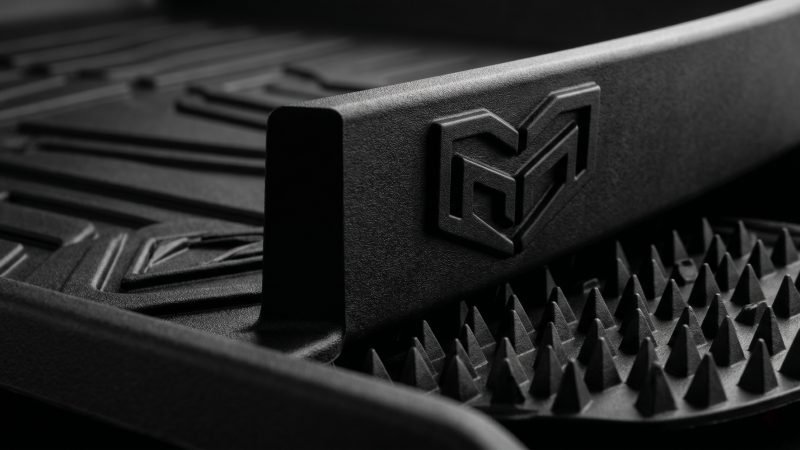
This is identical to how intricate textures are molded into plastic car bumpers. The pressurized, fluid material perfectly captures the exact surface finish of the mold cavity. Because of this, compression molding creates incredibly sharp, deep, and complex 3D logos.
Another massive advantage? Compression molding uses a closed, two-part mold. This allows manufacturers to design dual-sided textures. You can press a premium leather grain on the top surface while simultaneously pressing aggressive anti-slip spikes on the bottom surface.
| Design Feature | Vacuum Forming | Compression Molding |
|---|---|---|
| Wall Thickness | Thins out in deep corners | 100% uniform throughout |
| Texture Location | Single-sided only | Dual-sided capable |
| Pattern Integrity | Distorts during stretching | Deep, crisp, and permanent |
| 3D Logos | Soft, rounded edges | Sharp, highly detailed |
At the end of the day, vacuum forming works well for basic, low-profile designs. However, if your brand demands heavy-duty durability and complex dual-texture designs, compression molding offers unmatched capabilities.
Tooling Costs and Material Yield Analysis
When budgeting for a new floor mat production line, which process requires the highest initial tooling investment, and how much material actually goes to waste?
Vacuum forming utilizes single-sided aluminum molds, keeping initial tooling costs extremely low but generating higher edge scrap. Move over to compression molding, and you require heavy-duty, two-part steel molds that demand a massive upfront investment, though it dramatically reduces material waste to near zero.
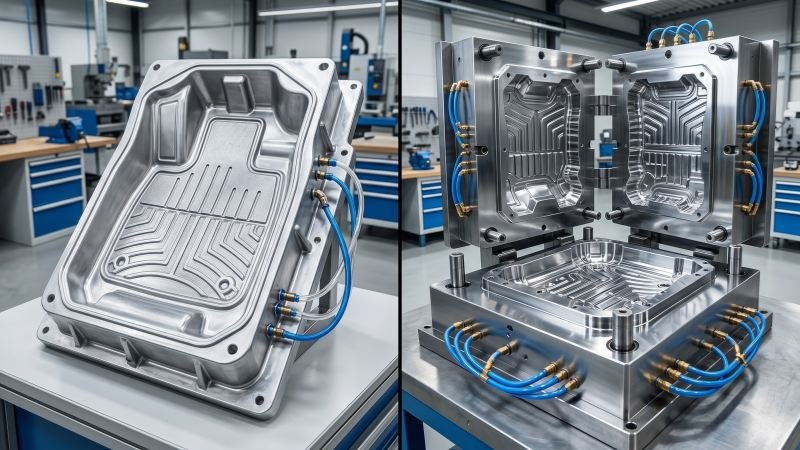
Aluminum vs. Steel Molds Investment Comparison
Initial tooling is the largest barrier to entry for car mat manufacturers. The mold materials used in these two processes dictate your starting costs.
Vacuum forming requires only a single-sided mold. Because the process relies on low negative air pressure, factories typically cut these molds from cast aluminum. Aluminum is soft and very easy to cut on a CNC router. As you’d expect, an aluminum mold is highly affordable. Tooling shops can often finish a new car mat mold in just one to two weeks.
Switch to compression molding, and you’re staring down a massive tooling budget. This process uses extreme hydraulic force. That means the molds must be machined from high-strength, hardened steel. To add complexity, compression molding requires a complex two-part mold consisting of a matching top and bottom cavity.
The harder metal requires much more time, tougher cutting tools, and greater expense. Cutting a two-part steel car mat mold can take four to eight weeks. It often costs four to five times more than an aluminum vacuum mold. Because mold lifespans and exact machining costs vary heavily based on the chosen steel grade and regional CNC shop rates, budgeting for compression molds requires careful long-term planning.
| Tooling Factor | Vacuum Forming | Compression Molding |
|---|---|---|
| Mold Material | Cast Aluminum | Hardened Steel |
| Mold Configuration | Single-sided (bottom only) | Double-sided (top and bottom) |
| Machining Lead Time | Very fast (1-2 weeks) | Very slow (4-8 weeks) |
| Upfront Investment | Low | Very High |
Scrap Rates and TPE Recyclability
How much plastic do you actually throw away during production? Material yield directly impacts your daily profit margins.
Vacuum forming inherently creates a lot of waste. The process always starts with a large, rectangular plastic sheet. However, vehicle floor mats feature highly irregular shapes. After the machine forms the mat, a robotic router must cut away the excess flat edges. The unavoidable result? The scrap rate in vacuum forming often reaches 30% to 40% per sheet.
This is a standard reality in continuous sheet-fed manufacturing. When a complex 3D shape is cut from a flat rectangular sheet, a large skeleton of unused plastic inevitably remains.
Compression molding? It generates almost zero waste. Operators load a precisely weighed, pre-plasticized TPE slug directly into the cavity. The melted material simply fills the exact volume of the mat. Flash, or tiny bits of material overflow on the edges, is minimal. The scrap rate usually stays strictly below 5%.
Does this make vacuum forming completely unprofitable? No. Modern car mats primarily use Thermoplastic Elastomer (TPE) or Thermoplastic Olefin (TPO). These materials act differently than traditional vulcanized rubber.
“Thermoplastic materials can be safely melted, ground down, and reformed multiple times without losing structural integrity.”
So, what’s the workaround? Factories do not throw away the 40% scrap from vacuum forming. Instead, they feed the edge trimmings directly into an industrial granulator. The factory then mixes this reground plastic with virgin pellets to extrude brand-new plastic sheets. At the end of the shift, while vacuum forming produces more immediate scrap, this excellent recyclability keeps the actual material loss very low.
Strategic Selection for Car Mat Manufacturers
How do you align the manufacturing process directly with your target customer base to maximize profitability?
To maximize profitability, you must select the manufacturing method that fits your sales volume and product positioning. Vacuum forming is the ideal strategy for aftermarket companies needing rapid product launches and high production volumes. On the other hand, compression molding is the definitive choice for premium brands and Original Equipment Manufacturers (OEMs) who require heavy-duty, luxury products.
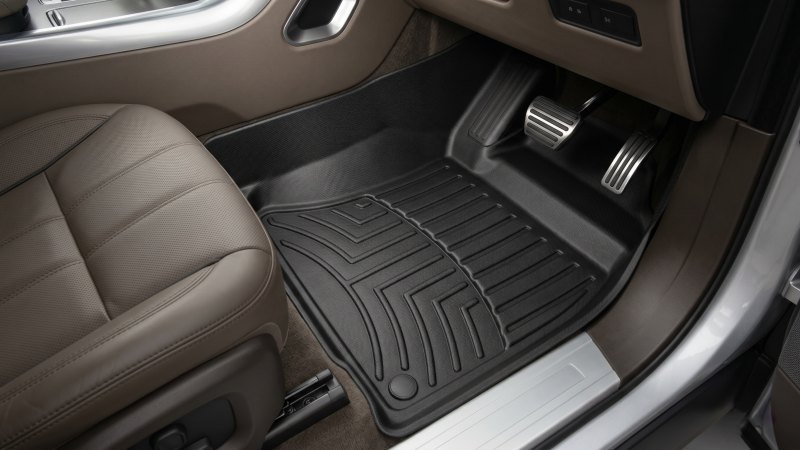
Ideal Market Scenarios for Vacuum Forming
The aftermarket car accessory industry moves incredibly fast. Every single year, automakers release dozens of new vehicle models. If you’re in the aftermarket game, you have to react quickly. If a new truck hits the market today, customers want protective floor mats for it tomorrow.
This is where vacuum forming truly shines as a business strategy. It allows companies to be incredibly agile. Manufacturers can 3D scan a new car floor, cut the necessary aluminum mold, and start selling mats in mere weeks.
Want to capture early market share before slower competitors even finish their heavy-duty tooling? Vacuum forming lets you do exactly that.
“Speed to market is the single most critical factor for capturing sales in the aftermarket automotive accessories sector.”
Because of this, vacuum forming is perfect for e-commerce brands offering hundreds of different Stock Keeping Units (SKUs). Factory operators can quickly swap lightweight molds on the thermoforming line to meet changing daily demands and support massive sales volumes.
When Compression Molding is the Better Choice
Sometimes, blazing speed is not the primary goal. Instead, maximum durability and a premium feel take absolute priority. In these specific scenarios, compression molding becomes the ultimate strategic choice.
Let’s look at Original Equipment Manufacturers (OEMs) first. When a consumer buys a luxury vehicle directly from a dealership, they expect perfection. The factory floor mats must feel heavy, lie perfectly flat, and endure years of severe abuse. Automakers typically lock in a single car interior design for five to seven years. For them, accepting long tooling wait times is a fair trade to achieve a flawless, heavy-duty final product.
Next up is the heavy-duty commercial truck market. Commercial fleet operators need incredibly thick, indestructible rubber or TPE mats. These products must survive muddy work boots and harsh chemicals daily.
This approach is similar to manufacturing industrial automotive suspension bushings. You invest heavily upfront in robust steel molds because the final solid part must survive extreme conditions without fail.
| Target Market Segment | Primary Business Goal | Recommended Manufacturing Process |
|---|---|---|
| E-commerce Aftermarket | Fast speed to market, high SKU count | Vacuum Forming |
| Luxury Dealership OEM | Maximum durability, premium aesthetic | Compression Molding |
| Commercial Truck Fleets | Extreme heavy-duty wear resistance | Compression Molding |
The takeaway here? If your brand positions itself at the top tier of the market, this process protects your reputation. Buyers will instantly notice the heavier weight and superior structural integrity.
Conclusion
Choosing between vacuum forming and compression molding ultimately comes down to a classic engineering trade-off: balancing speed against absolute precision. Vacuum forming offers unmatched agility, lower tooling barriers, and high-speed automated production, making it the dominant choice for fast-moving aftermarket e-commerce brands. Step up to compression molding, and you’ll face a higher initial investment and slower cycle times, but you’ll be rewarded with flawless thickness consistency, intricate dual-sided textures, and the heavy-duty quality demanded by premium OEMs.
If you need help evaluating your factory setup or deciding which production line fits your exact business model, please feel free to contact us.