-
Whatsapp +86 13526654721
-
Email: sales@carmatrolls.com
-
Address: AUX Industrial Park, Shangjie District, Zhengzhou City, Henan Province, China
-
Whatsapp +86 13526654721
-
Email: sales@carmatrolls.com
-
Address: AUX Industrial Park, Shangjie District, Zhengzhou City, Henan Province, China

Global Car Mat Market Trends: TPE vs. PVC vs. Carpet
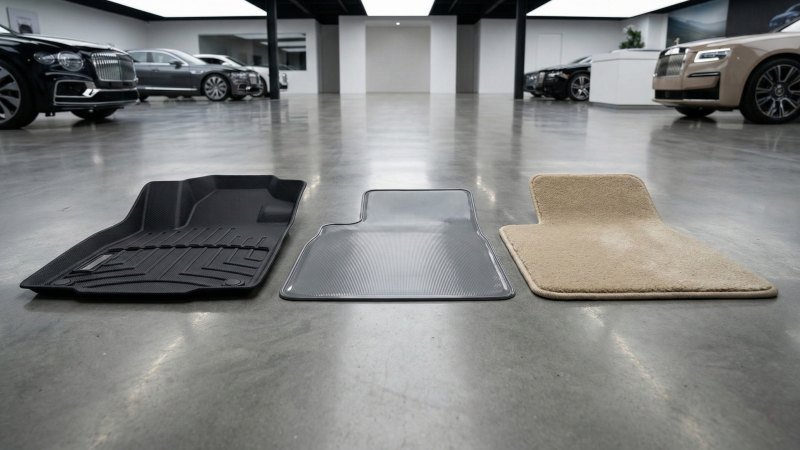
What is the primary difference between TPE, PVC, and Carpet car mats in the current market?
TPE (Thermoplastic Elastomer) is the emerging market leader, offering an odorless, recyclable, and waterproof solution that remains flexible in extreme temperatures. In contrast, PVC (Polyvinyl Chloride) acts as a budget-friendly but chemically odorous alternative that stiffens in the cold, while Carpet remains the traditional textile choice for aesthetic comfort but lacks the all-weather durability required for modern protection.
Defining the Three Major Material Competitors
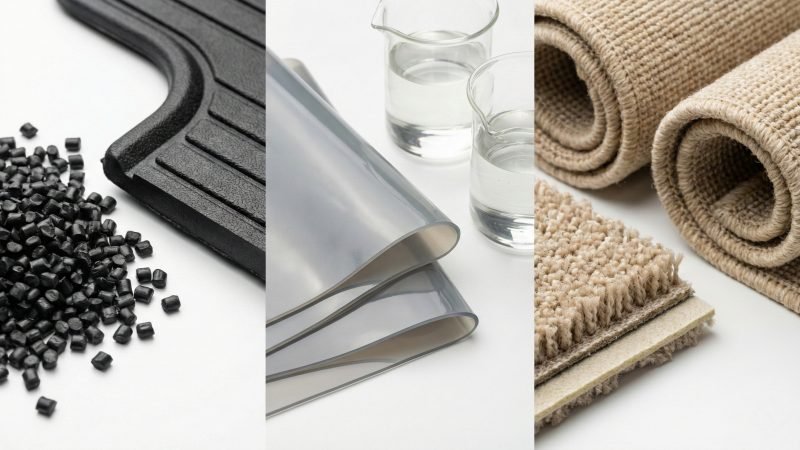
Automotive floor mats are categorized by their raw material structure: TPE (Thermoplastic Elastomer) is a recyclable polymer blend combining plastic and rubber properties; PVC (Polyvinyl Chloride) is a synthetic plastic that requires chemical additives for flexibility; and Carpet consists of woven fibers, such as nylon or polypropylene, tufted into a heavy backing.
TPE as the Advanced Eco-Friendly Polymer Solution
Thermoplastic Elastomer, commonly known as TPE, represents the modern standard in automotive accessories. Think of this material as a bridge between rubber and plastic. It possesses the flexibility of rubber but processes like plastic. This unique structure allows manufacturers to use Injection Molding. This process melts the material and shoots it into a mold, creating a mat that fits the car floor exactly.
In our world, TPE serves a similar function to door weatherstripping seals. It must remain flexible to seal gaps tightly against the elements, just as the rubber strips on a car door frame prevent rain and wind intrusion.
Key characteristics of TPE include:
- Composition: A physical mix of polymers (usually a plastic and a rubber).
- Production Method: Injection molding or blister molding.
- Recyclability: It can be melted down and reformed, unlike cured rubber.
Note: Specific TPE blends vary by supplier. Some use TPV (Thermoplastic Vulcanizate) for higher durability. Always verify the specific polymer blend with your manufacturer to ensure it meets your hardness requirements.
PVC as the Traditional Low-Cost Rubber Alternative
PVC (Polyvinyl Chloride) is a widely used plastic found in many older or budget-friendly car mats. Naturally, PVC is actually quite hard and rigid. To make it suitable for a floor mat, manufacturers must add chemicals called plasticizers, often containing phthalates. These additives force the stiff plastic to become flexible and rubber-like.
Here is the engineering reality: because it is not naturally flexible, the structure is fundamentally different from TPE. You might compare PVC mats to the vinyl dashboard covers in economy vehicles. While they look solid, they rely heavily on those added chemicals to maintain their tactile softness. Over time, as these chemicals degrade, the material returns to its natural, rigid state.
- Composition: Synthetic plastic polymer mixed with phthalates (plasticizers).
- Texture: Often feels slightly oily or “waxy” due to the additives.
- Weight: Generally heavier and denser than TPE counterparts.
Carpet as the Classic Textile Choice for Comfort and Luxury
Carpet mats are the traditional standard, often matching what comes with the car from the factory (OEM). These mats are defined by their textile construction. They are made by tufting fibers into a backing material. The quality of a carpet mat is usually measured by the density of these fibers.
Industry professionals use GSM (Grams per Square Meter) to define carpet quality. A higher GSM means a thicker, plusher mat.
- Standard Carpet: Around 400g-600g/m². Common in economy vehicles.
- Premium Carpet: 800g/m² and above. Found in luxury vehicles.
Think of the carpet mat like the acoustic headliner on a vehicle’s ceiling. It is designed for sound dampening and aesthetic uniformity rather than heavy-duty abrasion resistance. It creates a seamless look with the vehicle’s interior flooring.
| Feature | TPE (Thermoplastic Elastomer) | PVC (Polyvinyl Chloride) | Carpet (Textile) |
|---|---|---|---|
| Primary State | Flexible Polymer Blend | Rigid Plastic (Softened) | Woven Fiber |
| Manufacturing | Injection/Blister Molding | Compression Molding | Tufting/Weaving |
| Industry Analog | Door Weather Seals | Vinyl Dashboard Covers | Acoustic Headliners |
Performance Analysis in Different Environments
How do TPE, PVC, and Carpet mats actually perform when exposed to rain, snow, mud, and extreme temperature fluctuations?
In environmental performance testing, TPE and PVC provide superior moisture protection through impermeability, whereas Carpet absorbs liquids and requires extensive drying. However, TPE outperforms PVC in extreme temperatures, maintaining flexibility in freezing conditions where PVC often becomes brittle and cracks, while Carpet remains chemically stable but physically vulnerable to staining and mold growth.
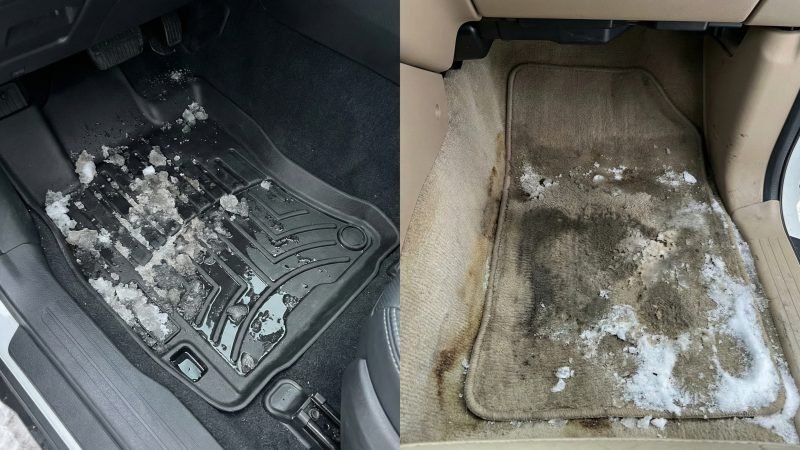
Waterproof Capabilities of Polymers versus Absorbency of Fabric Carpet
The fundamental difference in how these materials handle liquids dictates their suitability for different climates. TPE and PVC are non-porous polymers. When water hits them, it sits on the surface. This creates a “basin effect,” especially in modern 3D designs with raised edges. They function similarly to the windshield washer fluid reservoir under a car’s hood—effectively containing the liquid in a sealed unit until it can be drained.
Flip the script, and you have Carpet mats. They act like the felt wheel well liners found in many modern vehicles—they absorb water. Standard automotive carpet can hold significant moisture within its fibers and backing. In regions with heavy snowfall or rain, this absorption leads to saturation. If the mat becomes soaked, the moisture can seep through to the vehicle’s actual metal floor pan, potentially causing chassis rust over time.
- TPE/PVC: Hydrophobic (repels water). Liquid stays on top.
- Carpet: Hydrophilic (absorbs water). Liquid penetrates fibers.
Temperature Resilience and Cracking Issues in PVC
Temperature stability is the main technical differentiator between TPE and PVC. PVC (Polyvinyl Chloride) has a high sensitivity to thermal changes. In the automotive industry, this behavior is similar to standard rubber wiper blades in winter. In freezing conditions, the material stiffens significantly.
When PVC gets cold, the plasticizers that make it soft stop working effectively. This leads to Cold Cracking. If a user removes a frozen PVC mat to clean it, the material may snap or crack because it has lost its elasticity. Conversely, in high summer heat, PVC can become too soft and lose its molded shape, failing to protect the floor edges.
TPE, on the other hand, maintains stability across a much wider range. It behaves more like the silicone radiator hoses used in high-performance engines, which stay flexible and structural whether they are hot or cold. TPE mats generally remain flexible down to -58°F (-50°C) and stable up to 167°F (75°C).
Note: Temperature tolerance ranges can vary depending on the specific plasticizer ratio used by different PVC manufacturers. Always check technical data sheets to confirm the cold-crack rating.
Cleaning Efficiency Comparison Between 3D Molded Mats and Textiles
For car washes and detailing shops, the material dictates the labor time required. Cleaning a TPE or PVC mat is a surface-level operation. It involves a simple high-pressure rinse and a quick wipe-down. Because the material does not absorb water, it can be reinstalled immediately.
Carpet requires deep extraction cleaning. Dirt particles get trapped deep within the tufted fibers, requiring vacuuming and often chemical agitation. The biggest bottleneck is drying time. Just as a cloth car seat takes hours to dry after being shampooed, a wet carpet mat cannot be put back into the car immediately, or it will cause mildew.
Cleaning Workflow Comparison
| Metric | TPE & PVC Mats | Carpet Mats |
|---|---|---|
| Cleaning Method | Rinse & Air Dry | Vacuum & Shampoo Extraction |
| Drying Time | Instant (Wipe dry) | 2–4 Hours (Depends on humidity) |
| Stain Resistance | High (Wipes off) | Low (Stains penetrate fibers) |
| Detailing Cost | Low (Quick turnaround) | High (Labor intensive) |
Health, Safety, and User Experience Factors
Do the materials in your car mats actually impact your health and driving safety?
Materials like PVC release volatile organic compounds (VOCs) that degrade cabin air quality, whereas TPE is biologically inert and odorless. Furthermore, safety is determined by stability; TPE’s rigid structure prevents the “pedal entrapment” risks often associated with sliding carpet mats, making material choice critical for both passenger health and vehicle operation.
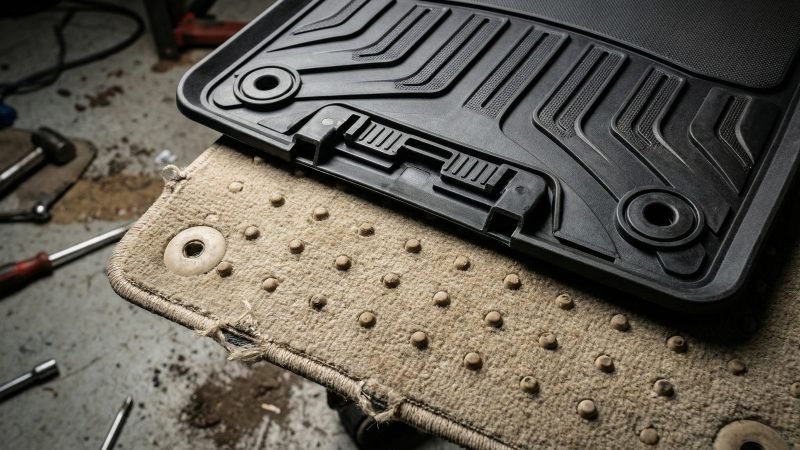
The Problem of Toxic Outgassing and Odors in PVC
Have you ever noticed the distinct “chemical” smell in a car with low-quality vinyl seat covers or dashboard plastics? That scent is caused by outgassing.
PVC (Polyvinyl Chloride) is naturally hard. To make it flexible enough for a floor mat, manufacturers must add liquid chemicals called plasticizers (phthalates). The problem is, these chemicals do not stay trapped inside the plastic forever. When your car is parked in the sun and the interior heats up, these chemicals evaporate into the air. This process is known as “fogging” because it often leaves a greasy film on the inside of the windshield.
For drivers, breathing these fumes can cause headaches or nausea. Do you really want your customers associating your product with that “new plastic” chemical headache caused by Volatile Organic Compounds (VOCs)? In contrast, TPE (Thermoplastic Elastomer) achieves flexibility through its polymer chain structure, not added liquid chemicals. Therefore, TPE mats are completely odorless and safe, even when the temperature inside the car rises above 100°F.
| Feature | PVC Mats | TPE Mats |
|---|---|---|
| Source of Smell | Chemical Plasticizers (Phthalates) | None (Material is naturally flexible) |
| Heat Reaction | Releases VOCs (Toxic fumes) | Remains stable and inert |
| Windshield Effect | Causes “Fogging” (Greasy residue) | No residue |
Grip and Anti-Slip Safety Features in TPE versus Carpet
The most dangerous thing a floor mat can do is slide forward and block your brake or gas pedal (pedal entrapment).
Carpet mats generally rely on small, sharp “nibs” or spikes on the bottom to dig into the car’s floor. While this works when the mat is new, these nibs can break off or wear down over time. Once that grip is gone, the mat acts like unsecured cargo in a truck bed—it slides easily with every turn or stop.
TPE mats use a completely different safety strategy called mechanical locking. Because they are injection molded to fit the exact 3D shape of the floor, they “snap” into place. The rigid walls press against the sides of the center console and door sill, physically preventing the mat from moving. Most TPE mats also include dedicated grommets that engage with the factory retention clips, offering a secure, mechanical connection similar to how interior trim panels are clipped onto the chassis.
The Aesthetic Appeal of Tufted Carpet versus Modern TPE Textures
Carpet is still the king of luxury perception. It adds “warmth” to the car’s interior. The tufted fibers also absorb sound, which helps reduce road noise (NVH – Noise, Vibration, and Harshness) for a quieter ride. For high-end luxury sedans, many buyers still prefer carpet because it functions like sound deadening material, softening the acoustic profile of the cabin.
But let’s look at where the industry is heading. TPE is rapidly changing the definition of “premium.” Early rubber mats looked like industrial truck parts. Modern TPE mats now feature sophisticated textures. Manufacturers use laser etching to create patterns that look like carbon fiber or technical fabrics.
While TPE cannot match the acoustic absorption of carpet, it offers a “high-tech” look. It signals to passengers that the car is clean, protected, and modern.
- Carpet Aesthetics: Soft, warm, traditional luxury, sound-absorbing.
- TPE Aesthetics: Sleek, technical, protective, waterproof finish.
Market Shifts and Profitability for Retailers
How are changing consumer preferences and material costs reshaping the business logic for automotive accessory retailers?
Current market data indicates a decisive shift where retailers prioritize TPE over PVC due to higher profit margins and growing consumer demand for all-weather protection. While OEM carpet remains the factory standard, the aftermarket sector is evolving towards premium hybrid solutions that combine durability with luxury, offering distributors significant opportunities for value-added sales.
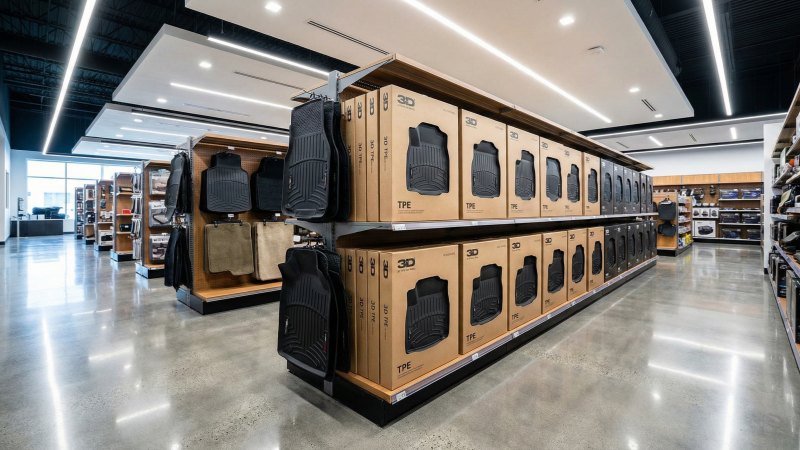
The Consumer Transition from OEM Carpet to All-Weather Protection
Historically, car owners viewed floor mats merely as decoration. They were satisfied with the flat, carpeted squares provided by the dealership. Today, the mindset has shifted toward asset protection. Consumers now treat their vehicles like expensive investments that need guarding.
You can compare this shift to the use of protective seat covers in work vehicles. Just as truck owners install heavy-duty canvas covers to preserve the original upholstery from wear, daily drivers now install 3D-molded mats to save their floorboards. The goal is to keep the underlying factory carpet in “mint condition” to maximize the car’s resale value.
Standard OEM carpet mats offer zero defense against spills. Modern consumers actively search for “deep dish” or “tray style” protection that catches the mess before it causes damage.
Why TPE Products Generate Higher Margins than PVC
For retailers and distributors, the choice between stocking TPE or PVC is often a financial calculation. PVC mats suffer from “commoditization.” Because PVC is cheap and easy to make, the market is flooded with low-cost options. This creates a “price war” where sellers must constantly lower prices to compete, resulting in very thin profit margins. Why fight a battle where the only winner is the one willing to lose the most money?
TPE mats command a higher “perceived value.” Because they are marketed as “custom-fit” and “odorless,” customers are willing to pay a premium price.
- PVC Economics: High volume, low price, low margin.
- TPE Economics: Lower volume, high price, high margin.
Here is the kicker: TPE molds (tooling) are expensive to produce. This creates a barrier to entry that prevents low-quality copycats from flooding the market quickly. A retailer selling a branded TPE kit can often mark up the product by 40% to 60%, whereas PVC mats often struggle to achieve a 20% margin due to intense competition.
Note: Mold costs and minimum order quantities (MOQs) for TPE production are significantly higher than PVC. Retailers should verify projected sales volume to ensure the initial tooling investment aligns with the budget.
The Emerging Trend of Hybrid Mats Combining TPE Bases with Carpet Layers
The newest innovation driving profit growth is the Hybrid mat. This product targets luxury car owners who want protection but hate the “industrial” look of rubber or plastic.
A hybrid mat consists of two distinct layers:
- Base Layer: A waterproof, 3D-molded TPE shell that fits the floor perfectly.
- Top Layer: A plush, removable carpet inlay that snaps onto the TPE base.
This design functions like a modular roof rack system. You have the sturdy base for utility, but you can add different attachments for style or function. In the summer or for business meetings, the driver keeps the carpet layer on for a luxurious feel. In the winter or for outdoor trips, they unclasp the carpet and use the waterproof TPE base underneath.
For retailers, this is a “Two-in-One” sales proposition. It eliminates the need for customers to buy separate summer and winter mats, justifying a significantly higher retail price point.
| Product Type | Target Customer | Retail Price Point |
|---|---|---|
| Universal PVC | Budget Shoppers | $ |
| Custom TPE | Daily Commuters | $$ |
| Hybrid (TPE+Carpet) | Luxury Owners | $$$ |
Conclusion
The industry writing is on the wall: the automotive accessory market is clearly moving away from the toxic, temperature-sensitive limitations of PVC. While traditional carpet still holds a place in the luxury segment, TPE has emerged as the definitive choice for modern, all-weather protection, offering superior safety, health benefits, and profitability. For retailers, the future lies in high-margin TPE solutions and innovative hybrid designs that offer the best of both worlds.