-
Whatsapp +86 13526654721
-
Email: sales@carmatrolls.com
-
Address: AUX Industrial Park, Shangjie District, Zhengzhou City, Henan Province, China
-
Whatsapp +86 13526654721
-
Email: sales@carmatrolls.com
-
Address: AUX Industrial Park, Shangjie District, Zhengzhou City, Henan Province, China

Car Mat Heel Pads: Metal vs. PVC vs. Carpet – Which is Best?
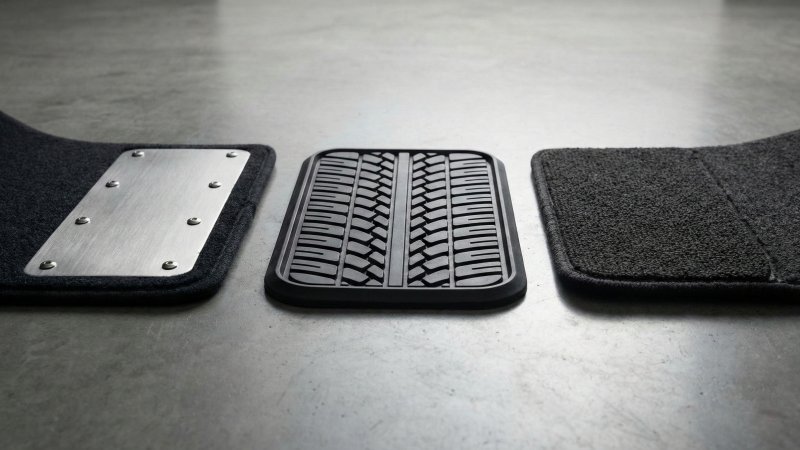
When selecting the ideal material for car mat heel pads, how do manufacturers balance durability, production costs, and driver safety to determine the best option?
The optimal choice depends on the specific balance of durability, cost, and target market application. Metal heel pads offer superior abrasion resistance and aesthetic appeal for luxury segments but require high labor costs. PVC compounds provide cost-effective, waterproof solutions for mass-market utility, while high-density nylon carpet reinforcements ensure seamless integration and comfort for OEM-style interiors.
Comparative Analysis of Raw Material Properties
What are the critical raw material differences between metal, PVC, and carpet for car mat heel pads?
Metal heel pads, typically crafted from stainless steel or aluminum, prioritize rigid structural integrity and corrosion resistance, requiring specific alloy selection to prevent rust. PVC and rubber compounds focus on flexibility and chemical stability, defined by their Shore A hardness and plasticizer quality. Carpet fibers, usually Nylon or Polypropylene, rely on denier count and pile density (GSM) to resist abrasion. Selecting the right material requires analyzing these physical properties to match the intended wear cycle.
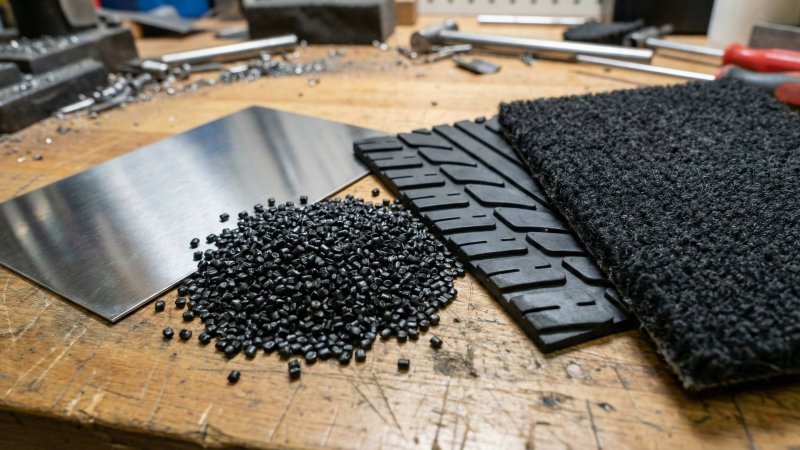
Sourcing High Grade Stainless Steel and Aluminum
When selecting metal for heel pads, the choice of alloy is the single most important factor. It determines whether the pad stays shiny or rusts after one winter. You are not just buying “metal”; you are buying a specific chemical composition.
Stainless Steel Selection
For stainless steel plates, SAE 304 grade is the industry standard for high-quality automotive accessories. It contains roughly 18% chromium and 8% nickel. This composition creates a passive layer that blocks rust, even when exposed to wet, salty shoes. In contrast, SAE 430 grade is cheaper and magnetic but lacks nickel. Consequently, 430 grade will eventually develop surface rust in humid automotive environments.
Think of this distinction like exterior automotive trim versus hidden seat bracketry. You need the exterior-grade resistance (304) for a heel pad because it faces the elements directly, whereas cheaper steel is only suitable for protected interior parts.
Aluminum Considerations
If you choose aluminum to reduce weight, look for 5052 or 6061 alloys. These offer good fatigue strength. However, raw aluminum is soft. It scratches easily under the constant friction of a rubber shoe heel. Therefore, aluminum sheets must undergo anodizing or powder coating before they are cut into pads.
Thickness Specifications
The thickness of the metal sheet dictates the feel of quality.
- 0.8mm – 1.0mm: Functional but may feel flimsy or bend if a heavy driver presses hard.
- 1.2mm – 1.5mm: Ideal for premium mats. It feels solid and resists denting.
Note: Thickness tolerances and alloy compositions can vary between metal batches. Always request a Mill Test Certificate (MTC) from your raw material supplier to verify the exact chemical breakdown.
Evaluating PVC Grades and Rubber Compounds for Molding
In the production of synthetic heel pads, the recipe of the compound is critical. A heel pad made from poor-quality PVC (Polyvinyl Chloride) will crack in freezing temperatures or smell toxic in the summer heat.
Shore A Hardness
The hardness of the material is measured on the Shore A scale. For a heel pad, you typically want a hardness between 60 and 80 Shore A.
- Below 60A: Too soft. It wears down quickly, similar to a soft pencil eraser.
- Above 80A: Too hard. It becomes slippery when wet and feels plastic rather than rubbery.
The Filler Problem
To cut costs, some suppliers mix large amounts of Calcium Carbonate (filler) into the PVC or TPE (Thermoplastic Elastomer) mix. While this makes the raw material cheaper, it weakens the molecular bond. A pad with high filler content will turn white when you bend it (stress whitening) and will wear a hole much faster.
Material Comparison Table
| Property | Standard PVC | TPE / TPR (Thermoplastic Rubber) |
|---|---|---|
| Temperature Range | Brittle in extreme cold | Flexible in cold; Stable in heat |
| Odor | Strong chemical smell (outgassing) | Low to no odor |
| Abrasion Resistance | Moderate | High |
| Recyclability | Difficult | Easy (can be remelted) |
For high-end production, TPE is often preferred over standard PVC because it mimics the grip of natural rubber without the high cost of vulcanization.
Selecting Heavy Duty Nylon and Polypropylene Carpet Fibers
When the heel pad is made of carpet (often called a “double heel pad”), it must be denser than the floor mat underneath it. Standard floor carpet cannot withstand the concentrated pressure of a driver’s heel.
Fiber Types
There are two main polymers used in automotive carpet manufacturing:
- Nylon (Polyamide): This is the superior choice for heel pads. Nylon fibers have excellent “memory,” meaning they bounce back after being stepped on. It has high abrasion resistance.
- Polypropylene (Olefin): This is cheaper and resists stains well. However, it crushes easily. Under a heel, polypropylene fibers will flatten out quickly, looking old after just a few months.
Understanding GSM (Grams per Square Meter)
In manufacturing, density is king. The durability of a carpet pad is directly linked to its GSM.
- Standard Floor Mat: Usually 450g to 600g.
- Required Heel Pad: Should be 800g to 1200g.
If you use a 600g carpet piece as a heel pad on a 600g mat, you are not adding protection; you are just adding a layer. The heel pad must be a heavier, tighter weave.
Construction Style
- Tufted Velour: Provides a smooth, premium look.
- Needle Punch: Denser and rougher. It is extremely durable but looks more industrial.
Using a needle punch pad on a tufted luxury mat is a common manufacturing mismatch. It solves the wear problem but lowers the visual value of the product.
Manufacturing Processes and Assembly Integration
How does the assembly technique determine the safety and longevity of a car mat heel pad?
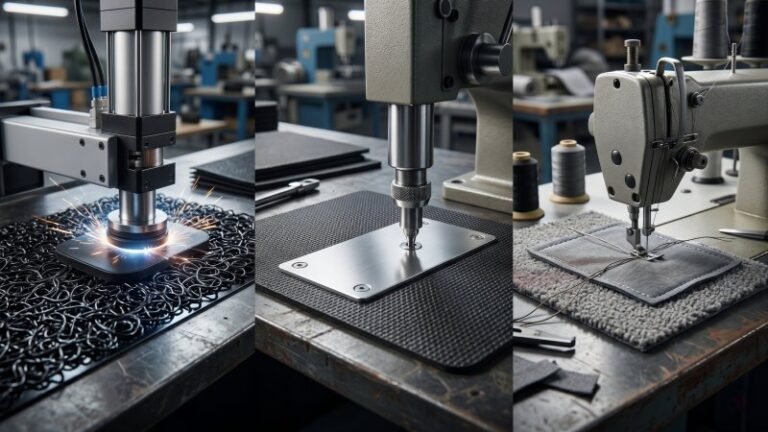
The structural integrity of a heel pad relies entirely on the fastening method; metal plates demand mechanical fixation via rivets to withstand shear force, PVC pads utilize High-Frequency (HF) welding for a molecular watertight seal, while carpet layers require thermal bonding reinforced by perimeter overlocking to prevent delamination.
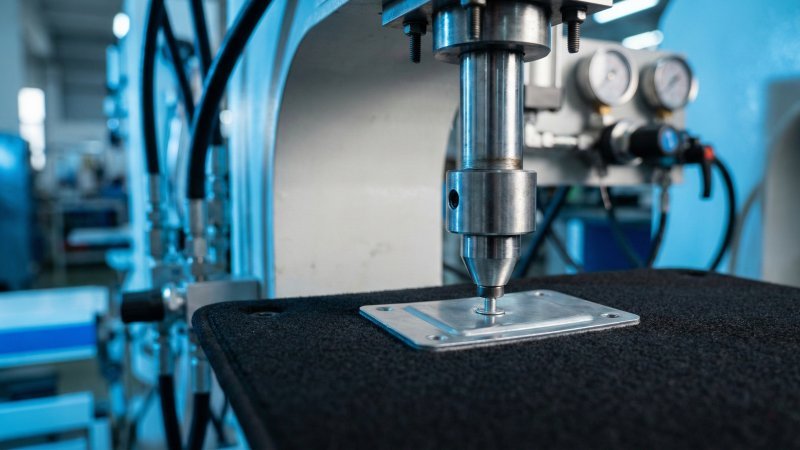
Riveting and Screw Fixation Techniques for Metal Plates
Attaching a rigid metal plate to a flexible floor mat creates a unique engineering challenge. You cannot use adhesives here. Glue acts poorly when two materials flex at different rates. Therefore, mechanical fasteners like rivets or screws are mandatory.
The Backing Plate Necessity
You should never secure a metal heel pad using only a washer on the underside. The soft material of the floor mat (TPE or carpet) will compress over time. Eventually, a small washer will pull right through the mat, causing the pedal to detach.
Instead, successful assembly requires a distribution backing plate. This is a strip of plastic or metal placed underneath the mat. It sandwiches the soft mat material between the top heel pad and the bottom plate.
Fastener Types
- Tubular Rivets: These are permanent. They are installed using a pneumatic press. This is the safest option because vibrations from the car engine cannot unscrew them.
- Threaded Screws: These allow the user to replace the pad. However, you must apply a thread-locking fluid (like Loctite) during assembly. Without it, the vibration will loosen the screws within months.
Note: Always ensure the rivet length exceeds the total thickness of the mat plus the plate by at least 2mm to allow for a proper “clench.”
High Frequency Welding versus Stitching for PVC Pads
When attaching a PVC or rubber heel pad, manufacturers must choose between melting it on or sewing it on.
High Frequency (HF) Welding
High Frequency (HF) welding, also known as Radio Frequency (RF) welding, does not use external heat. Instead, it uses electromagnetic energy to excite the molecules within the PVC. This causes the pad and the mat to melt together at the contact point.
- The Result: The pad and the mat become one single piece.
- Benefit: It is completely waterproof. There are no needle holes for water to leak through and damage the car’s original carpet.
- Limitation: This only works if both the heel pad and the base mat are made of compatible thermoplastics. You cannot weld PVC to carpet.
Stitching (Sewing)
If you are attaching a PVC pad to a carpet mat, you must use stitching.
- Needle Selection: Use a heavy-gauge needle (size 110/18 or larger) to penetrate the rubber without breaking.
- Thread Choice: Use bonded nylon thread. Cotton thread will rot when wet.
- The Risk: Every stitch creates a perforation. Water from muddy shoes can seep through these holes. To fix this, high-end manufacturers apply a waterproof sealant tape on the backside of the stitching line.
Comparison of Attachment Methods
| Feature | High Frequency Welding | Heavy Duty Stitching |
|---|---|---|
| Bond Type | Chemical/Molecular Fusion | Mechanical Interlocking |
| Waterproofing | 100% Sealed | Porous (Requires Sealing) |
| Material Compatibility | Must be similar plastics | Universal (Any material) |
| Visual Finish | Clean, seamless edges | Visible thread lines |
Overlocking and Heat Bonding Methods for Carpet Layers
A “double carpet” heel pad is the most comfortable option, but it is prone to curling at the edges if not assembled correctly. You cannot simply sew around the edge; the center will bubble up.
Thermal Heat Bonding
Before sewing, the heel pad must be laminated to the base mat. This is done using a Hot Melt Adhesive Film.
- The film is placed between the heel pad and the base mat.
- A heat press applies pressure (typically 3-5 bar) and heat (around 120°C – 150°C).
- The glue melts and locks the center of the pad down flat.
Perimeter Overlocking (Serging)
Once the center is bonded, the edges must be finished.
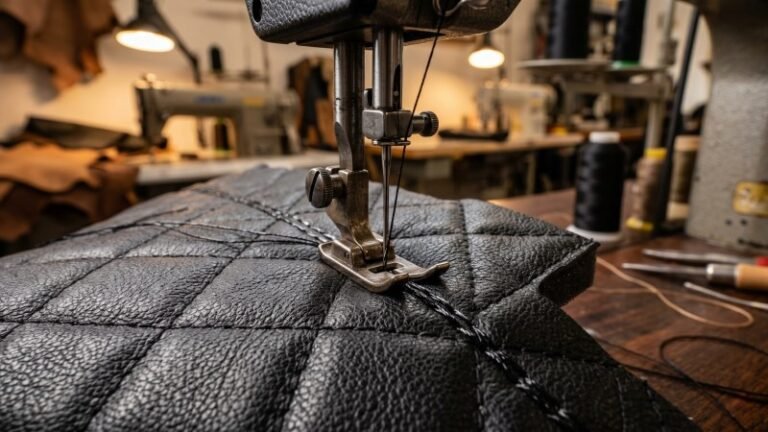
- The Process: An industrial overlock machine wraps yarn around the raw edge of the heel pad.
- The Function: This prevents the carpet fibers from unraveling. It also creates a smooth transition so the driver’s heel does not catch on the edge of the pad.
- Binding Tape: Some manufacturers replace overlocking with a binding tape (leather or nubuck). This is stitched over the edge for a cleaner, more premium look.
Think of this process like applying a reinforcement patch to a convertible soft-top. You must bond it first to keep it flat and integral, and then stitch the edges to ensure it withstands the constant movement without peeling. Without the initial heat bonding, the carpet pad would ripple under the movement of the driver’s foot.
Production Costs and Profit Margin Implications
How do material choices directly impact the unit cost and final profitability of car mat manufacturing?
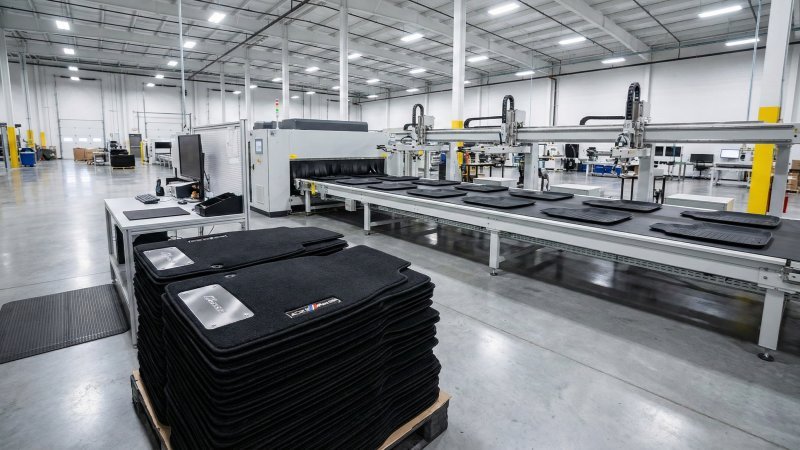
The cost structure varies significantly by material; metal heel pads incur the highest per-unit expense due to precision machining and finishing requirements, while PVC offers the lowest entry cost through high-volume injection molding. Carpet reinforcement occupies a middle ground, where costs are driven by fiber density and waste during cutting. Profit margins rely on balancing these initial outlays against the perceived market value of the finished product.
Raw Material Expenses per Unit Analysis
Understanding the “Bill of Materials” (BOM) is the first step in calculating profit. The cost difference between a metal plate and a PVC patch is not just pennies; it can be dollars per unit, which adds up in mass production.
Metal: The High-Cost Component
Stainless steel and aluminum are commodities sold by weight. However, the cost of a heel pad includes more than just the raw sheet.
- Material Waste: When stamping rectangular metal sheets into curved shapes, the offcuts (scrap) can account for 15-20% of the material cost.
- Finishing Costs: A raw metal plate is cheap, but a brushed or mirror-polished plate is expensive. The surface treatment often costs as much as the metal itself.
- Hardware: You must also buy screws or rivets. These small parts add roughly $0.10 to $0.25 per set to the BOM.
PVC: The Volume Game
PVC is sold by the kilogram.
- Efficiency: Injection molding produces almost zero waste because sprues (leftover plastic channels) can be reground and reused in-house.
- Cost Factor: A typical PVC heel pad weighs between 150g and 250g. If the raw material cost is $2.00/kg, the material cost for one pad is under $0.50. This makes it the cheapest option for raw materials.
Carpet: Density Equals Cost
Carpet is sold by the roll (square meters). The price is linear to the GSM (weight).
- The Trap: A cheap 400 GSM carpet pad costs little, but a durable 1100 GSM pad can cost three times as much.
- Cutting Loss: Unlike molding, cutting carpet shapes leaves significant waste material that cannot be easily recycled back into the process.
Unit Cost Comparison Estimate
| Material Type | Estimated Material Cost (USD) | Waste Factor | Hardware/Adhesive Cost |
|---|---|---|---|
| Stainless Steel (304) | $2.50 – $4.00 | High (Scrap metal) | High (Rivets/Screws) |
| Molded PVC/Rubber | $0.40 – $0.80 | Low (Recyclable) | Low (Welding/Stitching) |
| High-Density Carpet | $1.20 – $2.20 | Medium (Offcuts) | Medium (Binding/Glue) |
Note: These ranges are estimates. Always verify current raw material prices with your local suppliers, as metal and petroleum-based plastic markets fluctuate weekly.
Labor Intensity and Machinery Requirements
Buying the material is one thing; turning it into a product is another. The labor cost depends heavily on automation.
Metal: High Labor, High Skill
Installing a metal heel pad is rarely fully automated.
- Punching Holes: A worker or machine must punch accurate holes in the floor mat.
- Manual Assembly: A worker must physically align the plate, insert the screws, and attach the backing plate by hand.
- Time Cost: This manual process might take 60 to 90 seconds per mat. In a factory producing 1,000 mats a day, this is a massive labor expense.
PVC: High Capital, Low Labor
- Machinery: You need an expensive High-Frequency (HF) welding machine. This is a large upfront capital investment (CAPEX).
- Process: Once the machine is set up, the operator simply places the pad and presses a button. The weld takes 3-5 seconds.
- Result: One operator can finish hundreds of mats per hour. The labor cost per unit is tiny, even though the machine is expensive.
Carpet: The Skilled Operator
Sewing a carpet heel pad requires a skilled sewing machinist.
- The Skill Gap: It takes months to train an operator to sew a perfect curve without bunching the fabric.
- Speed: Sewing a double heel pad involves multiple steps (binding, positioning, stitching). It is slower than welding but faster than screwing on a metal plate.
Pricing Strategies for Premium versus Economy Lines
Your choice of heel pad dictates the final price tag you can put on the car mat set.
The “Value-Add” of Metal
Metal heel pads have a high perceived value. Customers associate metal with “custom,” “racing,” or “luxury.”
- Strategy: Even if the metal pad costs you $4.00 to make and install, you can often increase the retail price of the mat set by $15.00 or $20.00.
- Target: This works best for modified cars or premium SUVs where owners want visual upgrades.
PVC as the Standard Option
PVC pads are functional. They do not typically justify a price premium.
- Strategy: Use PVC to protect your margins on economy lines. It keeps the production cost low while ensuring the product lasts long enough to avoid warranty claims.
- Role: It is a defensive feature (preventing wear) rather than an offensive feature (attracting sales).
Carpet for the “OEM Plus” Market
High-quality carpet pads target buyers who want a factory look but better quality.
- Strategy: Price this between PVC and Metal. Market it as “Silent Luxury” or “Comfort Spec.”
- Differentiation: Use a carpet pad with a contrasting border color to create a unique selling point without adding significant cost.
Profit Margin Analysis Table
| Strategy | Base Cost | Production Complexity | potential Retail Markup |
|---|---|---|---|
| Economy (PVC) | Low | Low (Automated) | Low (Volume focus) |
| Mid-Range (Carpet) | Medium | Medium (Skilled Labor) | Medium (Quality focus) |
| Premium (Metal) | High | High (Manual Assembly) | High (Brand/Style focus) |
Quality Control and Warranty Risk Management
How can manufacturers scientifically predict heel pad failure rates before the product reaches the customer?
Effective quality control relies on standardized stress testing protocols: the Taber Abrasion Test (ASTM D3884) measures surface wear resistance, the Salt Spray Test (ASTM B117) validates corrosion immunity for metal components, and Peel Strength Testing ensures adhesive bonds withstand extreme cabin temperature fluctuations. Implementing these pass/fail benchmarks directly reduces warranty liability by identifying weak batches during pre-production.
Abrasion Resistance and Long Term Durability Testing
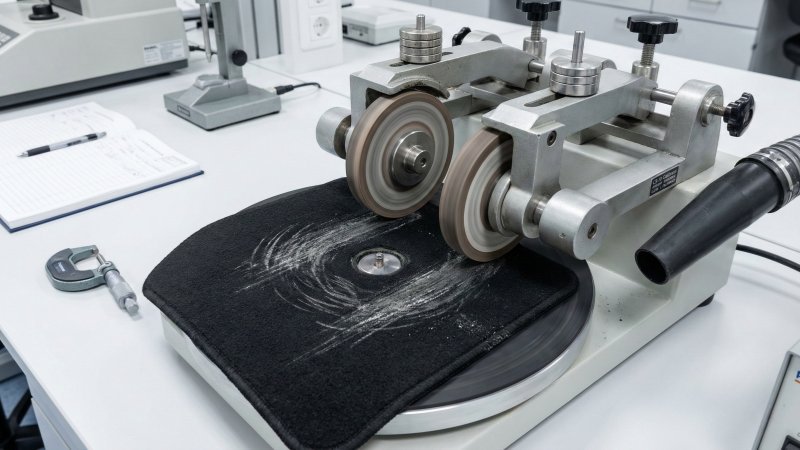
For a car mat manufacturer, the biggest nightmare is a customer returning a mat because the heel pad wore through in three months. To prevent this, you must test the material’s limit using a Taber Abraser.
The Taber Test Explained
This is the industry standard for testing wear. A sample of your heel pad (Carpet, PVC, or Painted Metal) rotates on a turntable. Two abrasive wheels rub against it under a specific weight.
- The Process: Think of it like a belt sander applying constant pressure to a specific spot on a wooden block, but with precise, calibrated force.
- The Measurement: You count the “cycles” (rotations) until the material fails. This testing methodology adheres to the widely accepted ASTM D3884 standard.
For a carpet heel pad, failure means the fibers are worn down to the backing. For PVC, failure means the texture is smoothed out.
Minimum Acceptance Criteria
Based on general automotive standards, your heel pads should meet these benchmarks:
| Material Type | Minimum Cycles (500g Load) | Failure Indicator |
|---|---|---|
| PVC / Rubber | 1,500 Cycles | Texture loss or color change |
| Carpet (Nylon) | 2,500 Cycles | Bald spots or fiber crushing |
| Coated Metal | 5,000+ Cycles | Coating breakthrough (base metal exposed) |
If your raw material supplier sends a batch of carpet that fails at 800 cycles, reject it immediately. It will not last a full year of driving. Crucially, always verify the specific abrasion wheel type (e.g., H-18 or H-22) with your testing lab, as using the wrong wheel changes the results significantly.
Preventing Rust and Corrosion in Metal Components
Metal heel pads face a unique enemy: Road Salt. In winter, drivers track in snow mixed with magnesium chloride. This mixture is highly corrosive and eats through inferior metal quickly.
The Salt Spray Test (ASTM B117)
You cannot just look at a metal plate to know if it will rust. You must use a Salt Spray Chamber. This machine creates a salty fog environment that accelerates corrosion according to the ASTM B117 protocol.
- 24 Hours in Chamber: Roughly equals 6 months of real-world use.
- 96 Hours in Chamber: Roughly equals 2-3 years of real-world use.
Identifying the Failure
When inspecting the samples after testing, look for two types of oxidation:
- White Rust: This is surface oxidation on aluminum or zinc. It looks chalky but is often cosmetic.
- Red Rust: This is iron oxide. It means the stainless steel is low quality or the protective coating has failed.
If you are selling “Premium Stainless Steel” pads, they must pass a 96-hour neutral salt spray test with zero red rust. If they rust after 24 hours, you are likely using low-grade 201 steel instead of 304, or the passivation layer was damaged during stamping.
Addressing Peeling and Seam Failures in Synthetic Pads
Sometimes the material itself is fine, but the attachment fails. This is common with PVC pads welded onto carpet mats or glued carpet-on-carpet pads.
The Heat Cycle Challenge
A car interior is a harsh environment. In summer, cabin temperatures can reach 60°C to 70°C (140°F – 158°F). In winter, they drop below freezing.
- The Risk: Adhesives and plastics expand and contract. If the bond is weak, the heel pad will peel up at the corners. This creates a tripping hazard for the driver.
Peel Strength Testing
To control this, you need a tensile testing machine (pull tester).
- Cut a 50mm strip of the finished mat including the heel pad edge.
- Clamp the mat in the bottom jaw and the heel pad in the top jaw.
- Pull them apart and measure the force required to separate them.
Troubleshooting Welding Failures
If your High-Frequency (HF) welded PVC pads are peeling off, check the tear seal. When you pull the pad off by force, the mat fibers should tear before the weld lets go. If the pad pops off cleanly without damaging the carpet underneath, the weld temperature was too low or the dwell time was too short.
Similarly, for stitched pads, inspect the stitch elongation. If the thread snaps when the mat is bent, the tension on your sewing machine is too tight. The thread must have enough slack to flex with the rubber mat.
Strategic Material Selection for Target Markets
How do manufacturers determine which heel pad material aligns best with specific customer demographics and vehicle types?
Market positioning relies on matching material attributes to driver psychology: metal heel plates are marketed to performance enthusiasts seeking visual upgrades and abrasion resistance, PVC pads target utility-focused drivers requiring waterproof protection for high-traffic use, and carpet reinforcements cater to the luxury segment demanding seamless OEM aesthetics and acoustic comfort.
Positioning Metal Pads for Luxury and Sport Segments
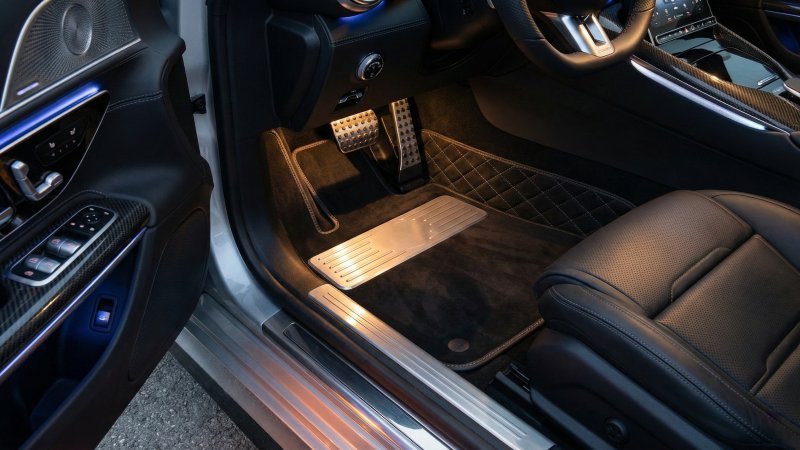
Metal heel pads are not just about protection; they are about style. In the automotive aftermarket, stainless steel and aluminum serve as “jewelry” for the car interior.
The “Tuner” Aesthetic
Consumers who buy metal pads often drive modified vehicles or sports cars. They want the interior to match the mechanical aggression of the engine.
- Visual Impact: A brushed stainless steel plate catches the eye immediately when the door opens. It signals high performance.
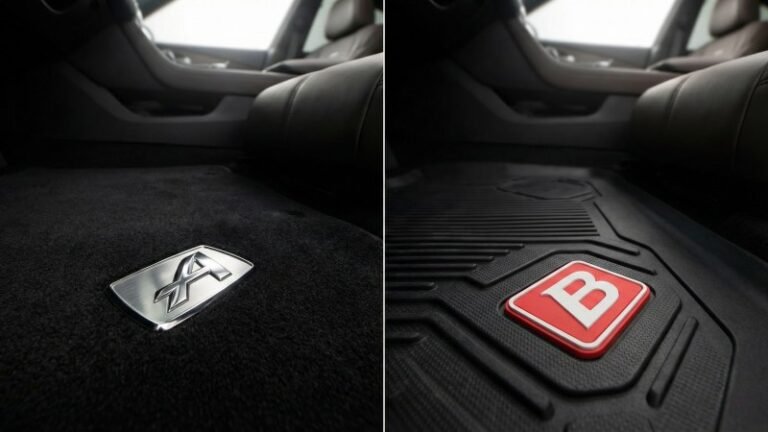
- Branding Opportunity: Metal offers a unique advantage for brands. You can laser-etch your logo directly onto the plate. Unlike a printed label on a carpet mat that fades, a laser-etched logo on steel is permanent.
The Luxury Up-Sell
Dealerships often use metal pads to upsell customers. A standard velour mat set might sell for $50. By adding a metal plate, the set becomes a “Premium Sport Edition,” allowing the dealer to charge $100 or more. The perceived value of metal is much higher than the actual cost of the material. For further reading on this strategy, review our guide on essential accessories for upselling.
Industry Insight: Tuning shops report that customers are 40% more likely to buy a mat set if it features a metal heel plate with a custom logo, even if the mat material itself is standard.
Utilizing PVC for All Weather and Mass Market Products
PVC and rubber heel pads are the workhorses of the industry. They are designed for function, not fashion. This is the volume volume seller.
The “Utility” Buyer
The target customer here includes taxi drivers, fleet operators, and parents with young families. They do not care about how “sporty” the mat looks. They care about mud, snow, and spilled coffee.
- Regional Strategy: In regions with heavy snowfall or rain (like Northern Europe or Canada), PVC pads are essential. A carpet pad will soak up water and smell bad. A PVC pad wipes clean instantly.
- Fleet Sales: When supplying mats for rental cars or company fleets, durability is the only metric. PVC pads survive the abuse of high-heeled shoes and heavy work boots better than carpet.
Marketing the “All-Weather” Benefit
When selling these, do not focus on luxury. Focus on maintenance.
- Key Selling Point: “Wipe-Clean Technology.”
- Target Vehicle: Trucks, SUVs, and economy sedans.
Market Segmentation Table
| Feature | Metal Target Market | PVC/Rubber Target Market |
|---|---|---|
| Primary Driver Goal | Aesthetics / Performance | Cleanliness / Durability |
| Vehicle Type | Sports Cars / Luxury Coupes | Family SUVs / Work Trucks |
| Price Sensitivity | Low (Willing to pay more) | High (Wants value) |
| Key Marketing Word | “Premium” | “Heavy-Duty” |
Adopting Carpet Reinforcements for OEM Style Collections
The third category is for the “Purist.” Many luxury car owners (Mercedes, BMW, Lexus) dislike the look of rubber or metal. They feel it makes the interior look cheap or industrial.
The “Invisible” Upgrade
For these customers, the goal is to make the mat look exactly like the original factory floor.
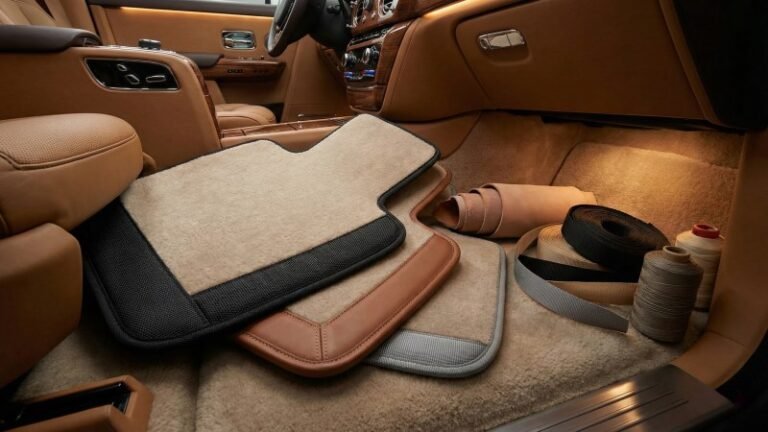
- Material Match: You must match the heel pad carpet pile to the base mat. If the floor is a tufted black velour, the heel pad must be the same black velour, just denser.
- Seamless Integration: The customer should not notice the heel pad is there until they realize it isn’t wearing out.
Comfort and Acoustics
Carpet pads offer a sensory advantage that hard materials do not: silence.
- Noise Reduction: Metal plates can clank if the driver wears hard-soled shoes. PVC can squeak when wet. Carpet is silent.
- Vibration Damping: Thick carpet absorbs the micro-vibrations from the chassis. This appeals to long-distance executive drivers who prioritize cabin silence over sporty looks.
Note: When sourcing carpet for OEM-style pads, ensure the dye lots match your base mats perfectly. Even a slight shade difference between the pad and the mat will look like a manufacturing defect to a luxury buyer.
Conclusion
Validating the heel pad material is a critical step in car mat manufacturing that impacts everything from production costs to brand perception. Whether opting for the rugged durability of metal, the cost-efficiency of PVC, or the refined comfort of high-density carpet, success lies in aligning the material properties with the specific demands of the target consumer. By strictly adhering to material standards and rigorous testing protocols, manufacturers can ensure product longevity and secure a competitive edge in the automotive aftermarket.