-
Whatsapp +86 13526654721
-
Email: sales@carmatrolls.com
-
Address: AUX Industrial Park, Shangjie District, Zhengzhou City, Henan Province, China
-
Whatsapp +86 13526654721
-
Email: sales@carmatrolls.com
-
Address: AUX Industrial Park, Shangjie District, Zhengzhou City, Henan Province, China

How Much Does It Cost to Start a Car Mat Factory?
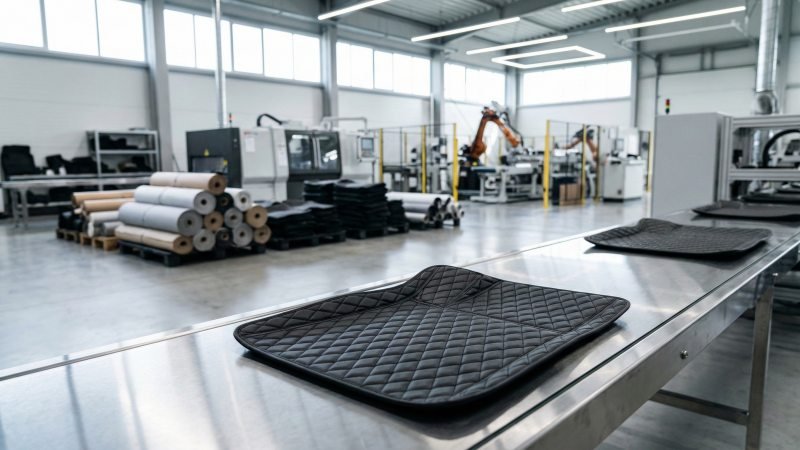
For entrepreneurs planning to enter the automotive interior industry, determining the precise startup capital is the most critical step. Starting a car mat business requires an investment ranging from approximately $15,000 to over $500,000, depending entirely on the production model selected, with the exact capital dictated by your business goals, equipment choices, and inventory strategy.
Cost Variations by Business Model
To accurately budget for your specific factory, you must distinguish between the two primary operational scales. The machinery and space requirements for these models are vastly different.
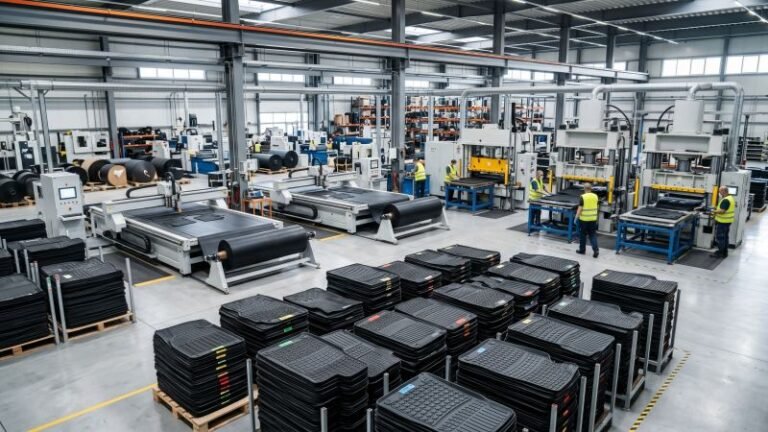
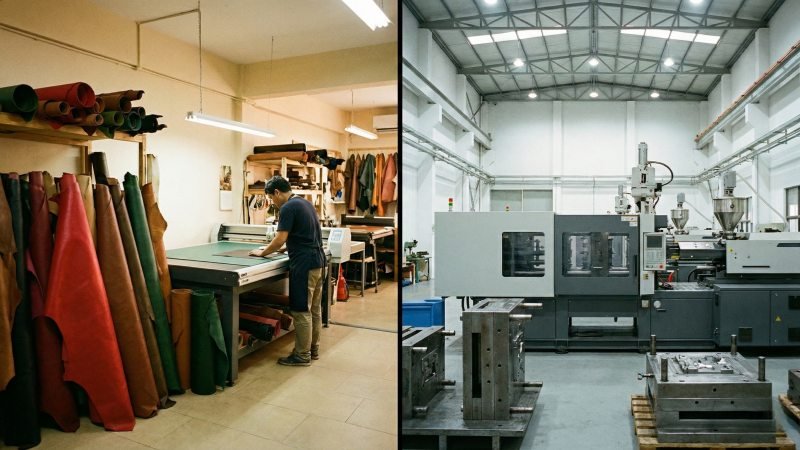
A small-scale “Cut & Sew” workshop typically costs between $15,000 and $50,000, focusing on customizing semi-finished materials. In contrast, an industrial “Injection Molding” factory requires $300,000 to $500,000+ due to the high expense of heavy machinery and steel molds.
The Workshop Model: Custom Cutting and Sewing
The workshop model is the most accessible entry point for new entrepreneurs. In this setup, you function essentially as a specialized finishing shop. Instead of creating the raw material yourself, you purchase semi-finished rolls of car mat material—such as PVC coil, faux leather, or carpet—from upstream suppliers. Your primary task is to cut these materials to fit specific vehicle floors.
Think of this model like an automotive upholstery shop that recovers seats. The shop does not weave its own fabric; it buys fabric rolls and cuts them to fit the specific seat frame. Similarly, a car mat workshop buys material rolls and cuts them to fit the car chassis. Because you are skipping the raw material production phase, your initial financial risk is significantly lower.
This model allows for “Just-in-Time” manufacturing. You do not need to stock thousands of finished mats. Instead, you keep rolls of material in stock and only cut a set when a customer places an order. Consequently, this drastically reduces the need for a massive warehouse.
However, the cost structure here is variable based on labor and technology. You can start with very low costs using manual cutting tools, but efficiency will be limited. Alternatively, investing in a digital flatbed cutter increases the initial cost but drastically lowers the labor cost per unit over time.
The Industrial Model: TPE Injection Molding and Mass Production
If your goal is to supply large distributors or car manufacturers (OEMs), you must consider the industrial model. This approach typically focuses on TPE (Thermoplastic Elastomer) mats. Unlike the workshop model, you are not cutting fabric. You are melting raw plastic granules and injecting them into a heavy steel mold to form a solid, 3D-shaped mat.
Consider the process of metal die-casting for engine parts. To make the part, the manufacturer must first build a high-precision mold, then melt the metal, and finally press it into shape under high pressure. The industrial mat factory works the same way. You take raw TPE pellets, melt them, and force them into a mold.
The primary cost driver in this model is tooling (molds). Since TPE mats are “custom fit,” you need a unique steel mold for every single car model you want to support. If you want to sell mats for a Toyota Camry, a Honda Civic, and a Ford F-150, you need three separate, expensive steel molds. Therefore, the startup cost multiplies with every new car model you add to your catalog.
This model is not about flexibility; it is about volume. Once the expensive mold is paid for, the actual cost of the plastic granules to make one mat is quite low. This allows for high profit margins on large orders, but the upfront “barrier to entry” is massive.
Comparison of Business Models
| Feature | Workshop Model (Cut & Sew) | Industrial Model (Injection Molding) |
|---|---|---|
| Primary Process | Cutting semi-finished rolls | Melting granules into molds |
| Initial Investment | Low ($15k – $50k) | High ($300k – $500k+) |
| Key Cost Driver | Material Rolls & Labor | Steel Molds & Heavy Machinery |
| Flexibility | High (Switch shapes instantly) | Low (Requires new mold for new shape) |
| Target Market | Retail, Custom Orders, Small Batches | Wholesale, Distribution, OEM |
Primary Equipment and Machinery Investment
Which specific machines must you purchase to start manufacturing car mats, and what is the price tag for each?
The primary machinery investment for a car mat factory ranges from $10,000 to over $300,000, driven by the chosen production technology. Essential equipment includes Automatic Digital Cutting Tables ($5,000–$25,000) for precise fabric trimming and High-Frequency Welding Machines ($3,000–$8,000) for attaching heel pads. For large-scale TPE production, heavy-duty Injection Molding Machines ($50,000–$150,000) and specific Steel Molds ($2,000–$5,000 per vehicle model) are required.
Automatic Digital Cutting Tables
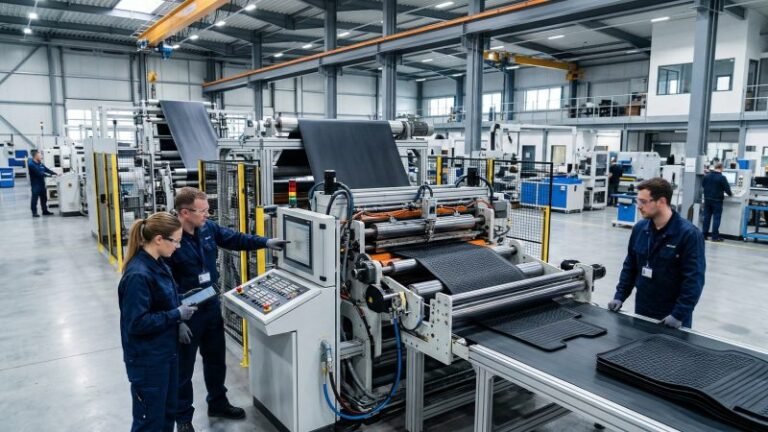
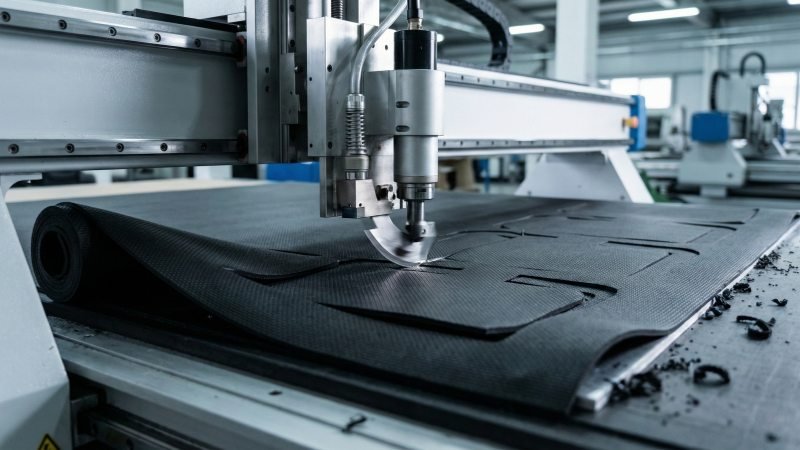
For any factory using the “Cut & Sew” model, the Automatic Digital Cutting Table is the heart of the operation. This machine replaces manual scissors and utility knives. It uses a computer-controlled head to slice through rolls of leather, PVC coil, or carpet with extreme precision.
Unlike a laser cutter, which burns through material, these machines typically use an Oscillating Knife. This blade moves up and down rapidly, similar to a jigsaw but with much finer control. This prevents the burnt edges and toxic fumes that often occur when cutting PVC materials with lasers.
The cost depends heavily on the cutting area and speed. A standard table (usually 1.6 meters wide) starts around $5,000 for basic Chinese-manufactured models. However, high-speed branded machines can exceed $20,000.
The biggest value of this machine is “Nesting.” The software arranges the mat shapes on the material roll to minimize waste. It fits the pieces together like a puzzle. This function alone can save 10-15% on raw material costs compared to manual cutting.
3D Car Floor Scanners and Design Software
Before you can cut or mold a mat, you need the exact dimensions of the car floor. In the past, workers used paper patterns. Today, professional factories use Handheld 3D Laser Scanners.
The process works like taking a digital 3D photo. An operator moves the scanner over the car’s floor area. The device projects laser lines and captures millions of data points to create a “point cloud.” This digital map is accurate to within 0.05mm.
Investment Breakdown:
- Hardware (Scanner): A reliable industrial scanner costs between $4,000 and $15,000. Cheaper consumer scanners often struggle with dark car carpets.
- Software (Reverse Engineering): You need software to turn the scan into a usable CAD file. Licenses for programs like Geomagic or specialized mat software can cost $2,000 to $10,000 per year.
Without this equipment, you must purchase data files from third parties. Owning a scanner allows you to develop new products immediately when a new car model is released.
Hot Pressing and High-Frequency Welding Machines
These machines are essential for finishing the product and adding durability. They are the “assembly tools” of the factory.
High-Frequency (HF) Welding Machines:
These are used primarily to attach the Heel Pad (the reinforced square under the driver’s feet). Instead of stitching the pad, which creates holes where water can leak, the HF machine uses electromagnetic waves. It heats the molecules of the material from the inside, fusing the pad to the mat permanently.
- Cost: Approximately $3,000 to $8,000 per unit.
Hot Pressing Machines:
If you produce “5D” or multilayer mats, you need a hot press. This machine acts like a high-tonnage thermal laminator. It takes layers of material (like surface leather, foam, and anti-slip backing), heats them, and presses them together into a single bonded sheet.
- Cost: Large hydraulic presses can range from $10,000 to $30,000.
Injection Molding Machines and Steel Molds
This equipment is specific to the Industrial Model for making waterproof TPE (Thermoplastic Elastomer) mats. This is the most capital-intensive section of the factory.
The Injection Machine:
This massive machine melts plastic pellets and injects them into a mold. It requires significant floor space and high-voltage power. For car mats, you typically need a machine with a clamping force of at least 800 to 1,000 tons because car mats have a large surface area.
- Machine Cost: A new 1,000-ton machine typically costs between $80,000 and $150,000.
The Steel Molds (Tooling):
The machine is useless without molds. The mold is the custom-carved steel block that shapes the plastic. You need a separate mold for every car model. If you want to make mats for a Tesla Model 3, you must buy a specific mold for it.
- Mold Cost: $2,000 to $5,000 per set.
This creates a cumulative cost. To launch a brand covering 50 popular car models, you might spend $150,000 just on molds, separate from the machine cost.
| Equipment Type | Estimated Cost | Function |
|---|---|---|
| Oscillating Knife Cutter | $5,000 – $25,000 | Cuts material rolls into shapes. |
| 3D Scanner & Software | $6,000 – $25,000 | Captures car floor dimensions. |
| High-Frequency Welder | $3,000 – $8,000 | Fuses heel pads without stitching. |
| Injection Molding Machine | $80,000 – $150,000 | Melts TPE for solid mats. |
| Steel Molds (Per Car) | $2,000 – $5,000 | Shapes the TPE (Recurring cost). |
Initial Raw Material and Inventory Budget
How much capital must you allocate for your first shipment of raw materials to ensure continuous production without overstocking?
The initial budget for raw materials typically ranges from $5,000 to $50,000, varying significantly based on the manufacturing process. A workshop focusing on custom cutting generally requires $5,000 to $15,000 to stock a diverse selection of semi-finished rolls like leather and PVC coil. Conversely, industrial factories using injection molding must allocate $30,000 to $50,000 to purchase bulk TPE granules and additives by the ton to meet supplier minimums.
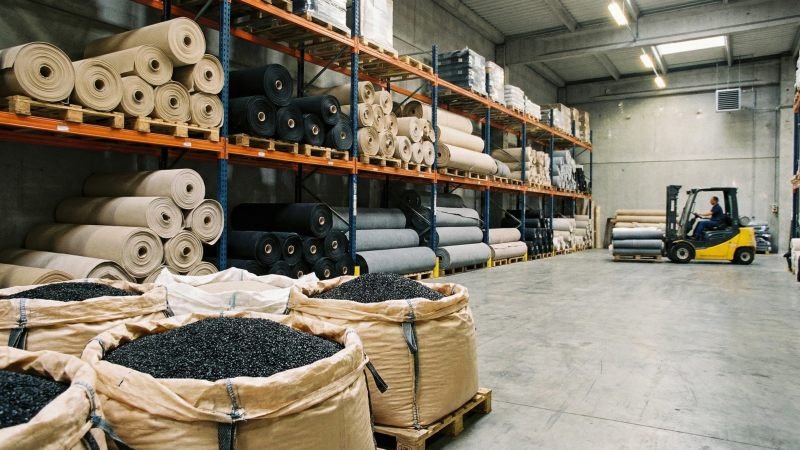
Stocking Semi-Finished Rolls for Custom Orders
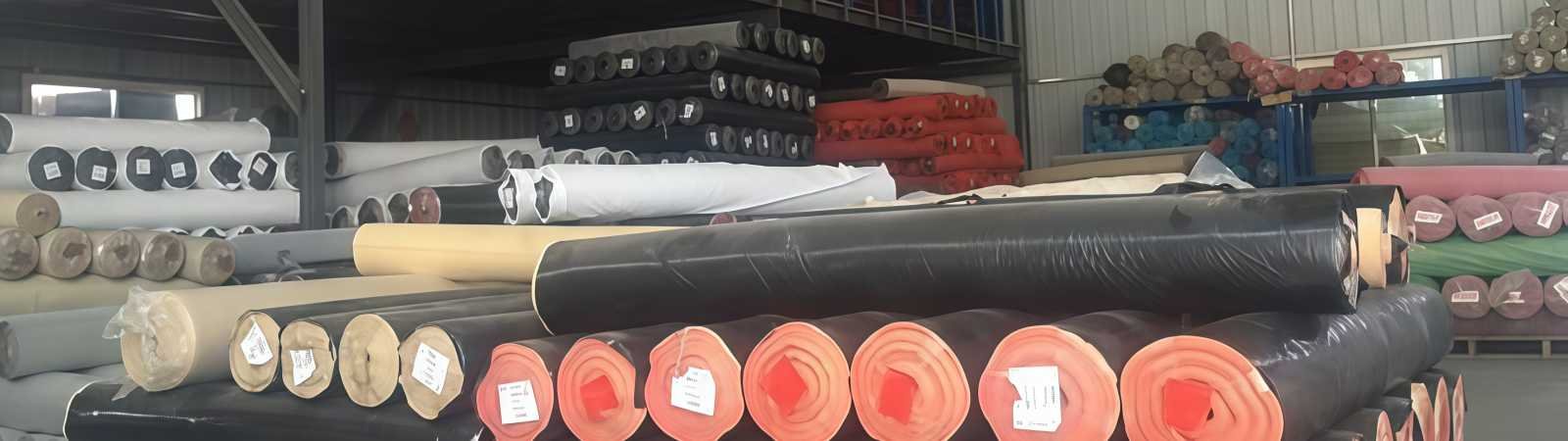
For factories operating on the “Cut & Sew” model, your inventory consists of large rolls of material. This is similar to a metal fabrication shop stocking sheets of aluminum, which they later cut to size. You are buying the “sheet,” not the finished product.
You will typically purchase these materials in rolls that are 1.5 to 1.6 meters wide and 10 to 50 meters long. The width is crucial because it must match the width of your digital cutting table. If you buy a roll wider than your machine, you cannot process it.
Common Material Types to Stock:
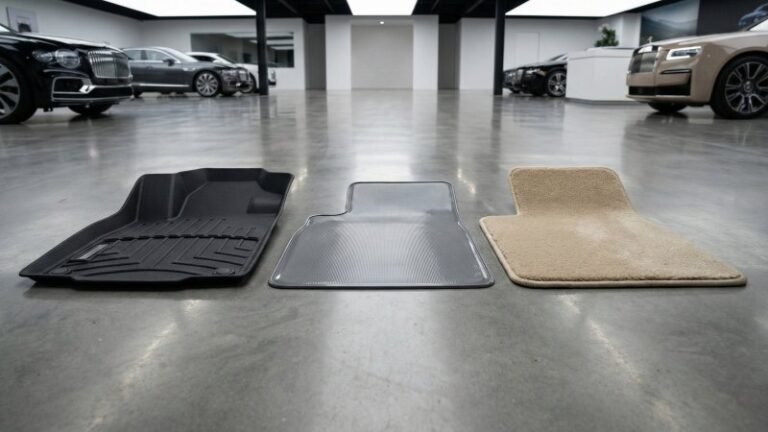
- PVC Coil (Spaghetti Mats): Durable and traps dirt.
- Faux Leather (Diamond Stitch): High-end look, often used for “5D” mats.
- Needle Punch Carpet: The standard OEM look found in most cars.
A single 50-meter roll of material might cost between $300 and $800, depending on the quality and thickness. From one such roll, you can typically cut 12 to 15 sets of car mats, depending on how efficiently your software nests the shapes.
Industry Insight: To start, you do not need every color. Focus 80% of your budget on Black, Grey, and Beige. These three colors account for the vast majority of consumer demand. Bright colors like red or blue often sit in the warehouse for months, tying up your cash flow.
Sourcing TPE Granules and Raw Plastics
If you operate an injection molding factory, you do not buy rolls. You buy small plastic pellets, known as granules. This is the raw ingredient. It is similar to a plastics manufacturer sourcing resin feedstock.
Understanding the Material:
You will primarily source TPE (Thermoplastic Elastomer). This material offers the rubber-like flexibility users want but can be processed like plastic. It is sold by weight, usually in 25kg bags stacked on pallets.
Cost Calculation Logic:
- Price Per Ton: TPE granules generally cost between $1,500 and $3,000 per ton.
- Usage Per Set: A full set of injection-molded car mats weighs approximately 4kg to 6kg.
- Yield: Therefore, one ton of raw material produces roughly 160 to 200 sets of mats.
You must also budget for Additives. You cannot just use raw TPE. You often need to add a “Masterbatch” (color pigment) to make the mats black, and UV stabilizers to prevent them from turning grey in the sun. These additives are more expensive per kilogram than the base plastic but are used in very small quantities (1% – 3% of the mix).
Minimum Order Quantity Requirements from Suppliers
The biggest challenge for a new factory is not the price of the material, but the Minimum Order Quantity (MOQ). Suppliers are manufacturers themselves; they will not turn on their machines to sell you just 10 meters of fabric or 100kg of plastic.
For Roll Materials:
Most textile factories require an MOQ of at least 300 to 500 meters per color. If you want to stock Black, Beige, and Brown leather, you might need to buy 1,500 meters total. This immediately pushes your initial spend up, even if you only have one customer.
For Granules (TPE):
Chemical suppliers typically sell by the container or truckload. The MOQ is often 1 to 5 tons. While 1 ton sounds like a lot, for an injection molding machine that cycles every 2 minutes, 1 ton of material can be consumed in just a few days of full production.
Strategies to Manage MOQ Costs:
- Consolidated Shipping: Ask a trading company to combine orders. You might pay a slightly higher price per unit to buy a smaller quantity (e.g., 50 meters instead of 500).
- Standard Colors: Stick to industry-standard black granules. Custom colors often have much higher MOQs because the supplier has to clean their entire production line to switch colors for you.
| Inventory Type | Unit of Measure | Approx. Cost | Minimum Order (MOQ) |
|---|---|---|---|
| PVC/Leather Rolls | Meters | $6 – $15 per meter | 300 – 500 meters |
| TPE Granules | Tons / Kg | $1.50 – $3.00 per kg | 1 – 5 Tons |
| Packaging Boxes | Pieces | $1.50 – $3.00 per box | 500 – 1000 pieces |
Operational Overheads and Hidden Fees
What monthly operational expenses and hidden costs should you expect when running a car mat production facility?
Operational overheads typically range from $5,000 to $20,000 per month for small workshops, escalating to over $50,000 for industrial plants. Key recurring expenses include facility rent ($10–$15 per sq. meter), specialized high-voltage electrical infrastructure for heavy machinery, labor costs for skilled operators, and often-overlooked logistics fees like volumetric shipping charges for bulky finished mats.
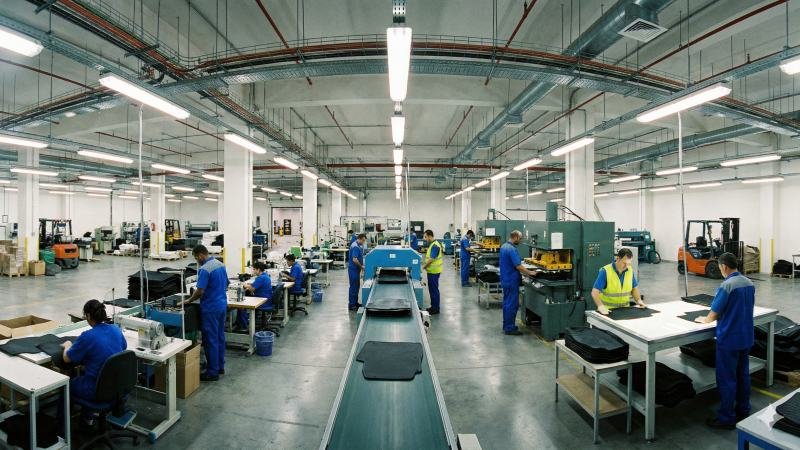
Factory Space and Electrical Infrastructure Setup
Finding the right building is about more than just square footage. You must consider the specific physical layout required for car mat production lines.
Space Requirements:
For a “Cut & Sew” workshop, you generally need 150 to 300 square meters. This provides enough room for the long digital cutting table (usually 3 meters long) and shelves to store material rolls horizontally.
For an Injection Molding factory, the requirement jumps to 1,000+ square meters. The molding machines are massive, but the real space-eater is the cooling area. Hot mats coming out of the mold need space to cool down flat without warping.
Electrical Infrastructure (The Hidden Cost):
This is where many new factory owners get surprised. Industrial machines do not plug into standard wall outlets.
- 3-Phase Power: Injection molding machines and large hydraulic presses require 3-phase industrial power (380V or 480V). If your building does not have this, installing a new transformer can cost over $10,000.
- Compressed Air: Your digital cutting table uses a vacuum to hold the fabric down. This requires a powerful industrial air compressor. You must plumb the factory walls with air lines to deliver this pressure to the machines.
Important: Always check the “Total Kilowatt Load” of your machinery list before signing a lease. Ensure the building’s electrical panel can handle that load plus a 20% safety margin.
Labor Costs for Machine Operators and Sewers
The type of worker you hire depends entirely on your chosen business model. The skills required for sewing are very different from those needed for molding.
Skilled Sewers (Craftsmanship):
If you are making leather or coil mats, your quality depends on the sewer. Attaching the edging tape (binding) around the mat requires a steady hand. If the stitching is crooked, the product looks cheap. Experienced industrial sewers command higher wages because their skill directly impacts the visual quality of the product.
- Training Time: It often takes 2-3 months to train a new employee to sew curves smoothly without bunching the fabric.
Machine Operators (Process Control):
For TPE injection molding, you need technicians, not craftsmen. Their job is to monitor the settings on the machine—temperature, pressure, and cooling time. They do not physically shape the mat; the machine does that.
- Role: One operator can often supervise two machines at once, reducing labor cost per unit. However, you also need a Mold Setter. This is a stronger, more skilled worker responsible for using a crane to swap the heavy steel molds when you change from producing Toyota mats to Honda mats.
Packaging and Logistics Expenditures
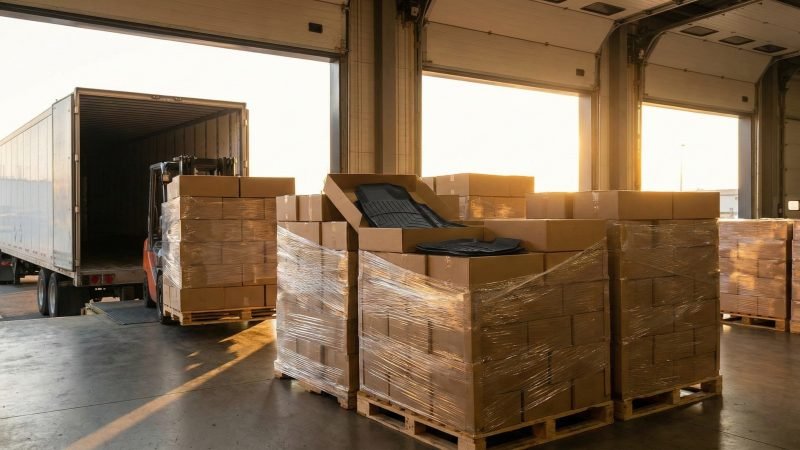
Shipping car mats is expensive because they are deceptive. They are relatively light, but they are physically large and cannot be folded tightly without creasing.
The “Volumetric Weight” Problem:
Logistics companies charge based on space, not just dead weight. A set of car mats might only weigh 6kg. However, because the box is large (e.g., 80cm x 60cm x 15cm), the carrier calculates the Volumetric Weight at perhaps 12kg or 15kg. You pay for the 15kg rate.
Packaging Costs:
You cannot use cheap, thin cardboard. Because mats are large and flat, heavy boxes stacked on top of them during shipping can crush the box. You need double-wall corrugated cartons.
- Cost: A custom-printed box strong enough for shipping typically costs $2.00 to $3.50 per piece.
- Accessories: You also need plastic hangers or plastic bags for internal protection, adding another $0.50 per set.
Returns and Defect Management:
If a customer orders a mat for a 2020 BMW X5, but you send a mat for a 2024 BMW X5, it will not fit. The return shipping cost often exceeds the profit margin of the product. Unlike a small phone case, you cannot easily mail a car mat back cheaply. Therefore, your “Quality Control” station before packaging is the most critical step to save money on logistics.
| Expense Category | Estimated Monthly Cost (Small Scale) | Key Considerations |
|---|---|---|
| Rent & Utilities | $2,000 – $4,000 | Needs high ceilings and industrial power. |
| Labor (3-5 Staff) | $8,000 – $15,000 | Skilled sewers are harder to find than general labor. |
| Packaging Material | $500 – $1,500 | Strong boxes are required to prevent crushing. |
| Machine Maintenance | $200 – $500 | Replacing cutter blades and compressor oil. |
Analyzing Profitability and ROI
How long does it take for a car mat manufacturing business to become profitable, and what are the typical profit margins per unit?
The Return on Investment (ROI) for a car mat factory varies largely by scale, with gross profit margins typically falling between 30% and 60%. A small “Cut & Sew” workshop often reaches its break-even point within 6 to 12 months due to lower startup costs. Conversely, a large-scale “Injection Molding” facility usually requires 18 to 24 months to recover its initial capital due to the heavy investment in machinery and steel molds.
Calculating Cost Per Set versus Market Price
To understand your potential profit, you must calculate the “Landed Cost” of a single set of mats. This includes the material, the labor time, and the machine wear.
Unit Economics for a “Cut & Sew” Mat (Example: PVC Coil):
In a workshop setting, the main cost is the material roll.
- Material Cost: A high-quality PVC coil roll costs about $10 per meter. A standard 5-seat sedan requires roughly 2.5 meters of material. This puts the base material cost at $25.00.
- Labor & Overhead: Adding labor (cutting and sewing time) plus electricity might add another $5.00.
- Total Production Cost: Approximately $30.00.
- Retail Price: These sets typically sell for $80.00 to $120.00 online.
- Gross Margin: You earn roughly $50 to $90 per set.
Unit Economics for an Industrial TPE Mat:
Here, the math is different. The material is cheaper, but the setup is expensive.
- Material Cost: TPE granules are bought by weight. A set weighs about 5kg. If TPE costs $2.00/kg, the material cost is only $10.00.
- Mold Amortization: This is the critical factor. If a mold costs $3,000, and you only make 100 sets, the mold cost is $30 per set. However, if you make 3,000 sets, the mold cost drops to just $1.00 per set.
- Total Production Cost (at volume): Can be as low as $15.00 to $20.00.
- Retail Price: Custom TPE mats often sell for $120.00 to $200.00.
Note: Raw material prices for PVC and TPE fluctuate based on global petroleum markets. Fluctuations in oil prices directly impact plastic production costs.
| Cost Component | Cut & Sew Workshop (Per Set) | Injection Molding Factory (Per Set) |
|---|---|---|
| Raw Material | $25.00 (High) | $10.00 (Low) |
| Labor | $5.00 (High – Manual work) | $2.00 (Low – Automated) |
| Tooling/Mold Cost | $0.00 | $1.00 – $30.00 (Volume dependent) |
| Total Unit Cost | ~$30.00 | ~$15.00 – $40.00 |
| Market Retail Price | $80.00 – $120.00 | $120.00 – $200.00 |
Break-Even Timeline for Different Factory Scales
The “Break-Even Point” is the day your total profits equal your initial startup money. This timeline depends heavily on your sales volume and your initial equipment selection.
Timeline for the Workshop Model (Fast Return):
Since you only spent roughly $20,000 to $30,000 on equipment (as detailed in previous sections), the risk is low.
- If your net profit is $40 per set, you need to sell roughly 500 to 750 sets to pay off your machines.
- A small shop selling just 3 sets a day (roughly 90 per month) can pay off the entire investment in roughly 6 to 8 months.
- This creates cash flow quickly, allowing you to buy more designs or better leather rolls.
Timeline for the Industrial Model (Long-Term Gain):
Here, you might have invested $300,000+.
- You need to sell roughly 10,000 sets to break even.
- This model relies on B2B contracts. You cannot sell this volume easily to individual car owners one by one. You need bulk orders from car dealerships or large distributors.
- Securing these contracts takes time. Therefore, an industrial factory often runs for 1.5 to 2 years before seeing “true profit” after covering the machine and mold debts.
However, once that threshold is crossed, the industrial model is far more scalable. A machine can run 24 hours a day, whereas a person sewing mats gets tired. The industrial factory eventually generates much higher total revenue, despite the slower start.
Conclusion
Choosing between a workshop model and an industrial factory depends on your capital, risk tolerance, and target market. A workshop offers a lower barrier to entry with quick returns, ideal for custom retailers. An industrial plant requires significant upfront capital but offers lower unit costs and high scalability for B2B supply.
Ready to calculate your specific factory startup costs?
Every market is different, and material costs change daily. We can help you build a custom equipment list and budget plan based on your target production volume, so please contact us for a personalized consultation.