-
Whatsapp +86 13526654721
-
Email: sales@carmatrolls.com
-
Address: AUX Industrial Park, Shangjie District, Zhengzhou City, Henan Province, China
-
Whatsapp +86 13526654721
-
Email: sales@carmatrolls.com
-
Address: AUX Industrial Park, Shangjie District, Zhengzhou City, Henan Province, China

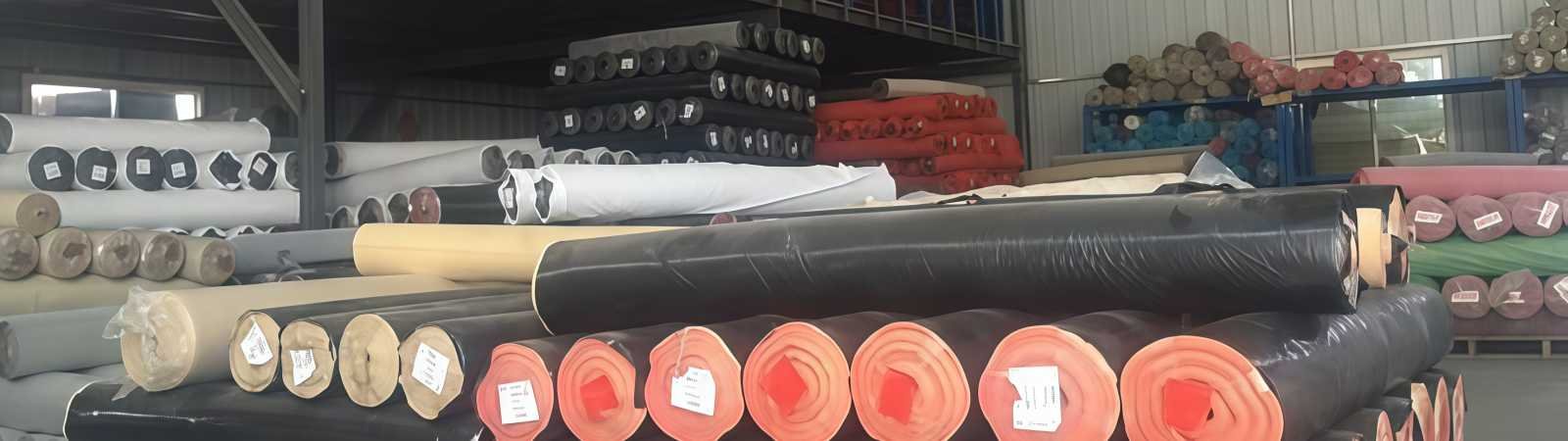
The Ultimate Guide to Car Mat Manufacturing: Machines, Materials, and Processes
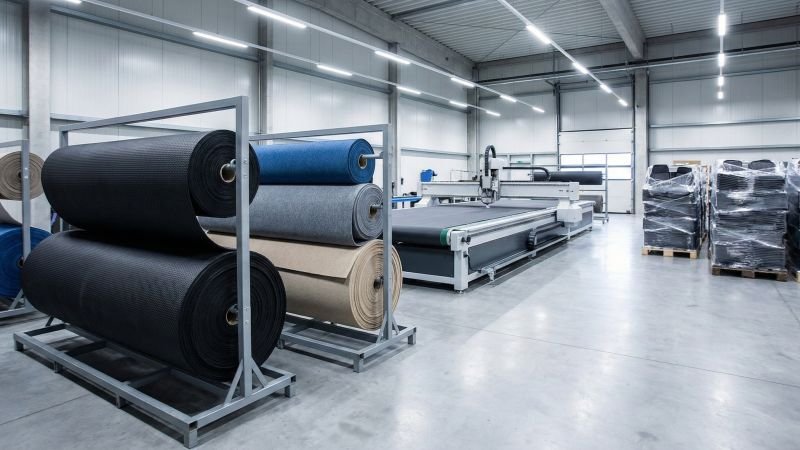
What are the essential components and comprehensive processes involved in professional car mat manufacturing?
Car mat manufacturing is a multi-stage industrial process that integrates advanced material selection—ranging from traditional PVC to modern TPE and XPE composites—with precise fabrication technologies. The production workflow typically requires a synchronized combination of 3D laser scanning for vehicle data acquisition, automated oscillating knife cutting, hydraulic compression molding, and rigorous quality control protocols to ensure safety and durability standards are met.
Essential Raw Materials for Modern Car Mats
The foundation of any high-quality car mat lies in the selection of appropriate raw materials, which defines the product’s market positioning and manufacturing requirements.
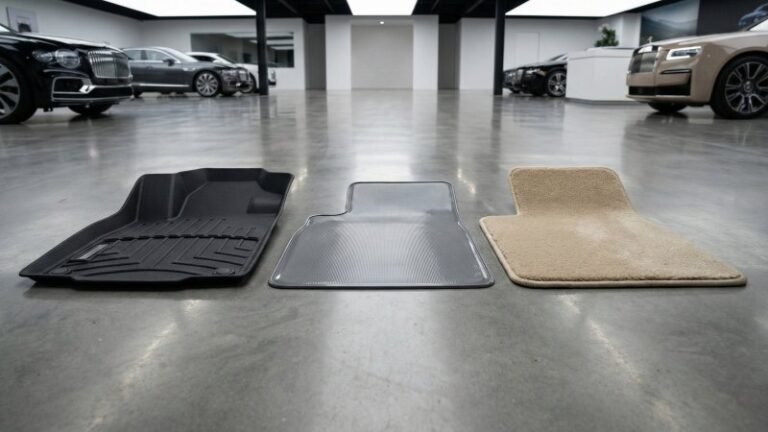
Manufacturers primarily utilize a spectrum of materials ranging from traditional PVC and synthetic rubber for heavy-duty economy mats to advanced TPE (Thermoplastic Elastomer) granules and multi-layer XPE composites for premium, all-weather protection. The choice of raw material dictates not only the final product’s durability, odor profile, and aesthetic appeal but also determines the necessary production techniques, such as injection molding or hot pressing.
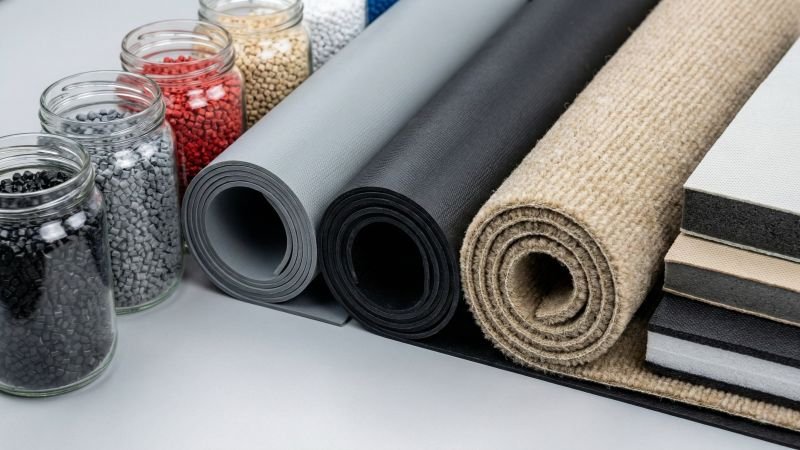
Traditional Options: PVC and Synthetic Rubber
For decades, Polyvinyl Chloride (PVC) and synthetic rubber have served as the industry standard for “all-weather” mats. You will typically find these materials in heavy-duty, universal-fit mats sold in big-box retail stores.
PVC offers a significant advantage in terms of raw cost. It is readily available and easy to color. However, PVC has a notable downside regarding temperature sensitivity. In extreme cold, PVC tends to stiffen and may crack, similar to how older plastic wiring insulation becomes brittle over time. Conversely, in high heat, lower-quality PVC can release volatile organic compounds (VOCs), resulting in that distinct “chemical smell” inside a vehicle.
Synthetic rubber, often NBR (Nitrile Butadiene Rubber) or SBR (Styrene Butadiene Rubber), offers superior flexibility compared to PVC. It provides excellent resistance to oil and grease. Yet, it is dense. A set of thick rubber mats can be significantly heavier than modern alternatives, which negatively impacts shipping costs and fuel economy considerations.
Material Comparison: PVC vs. Rubber
| Feature | PVC (Polyvinyl Chloride) | Synthetic Rubber |
|---|---|---|
| Cost | Low | Medium |
| Flexibility | Poor in Cold Weather | Excellent |
| Odor | High (in heat) | Moderate (Rubber smell) |
| Weight | Heavy | Very Heavy |
| Recyclability | Difficult | Moderate |
Carpet and Textile Materials for Luxury Segments
When the goal is to replicate or upgrade the OEM (Original Equipment Manufacturer) look, textile materials are the primary choice. These mats provide a plush feel and acoustic dampening that rubber products cannot match.
The industry generally divides these materials into two categories: Polypropylene and Nylon. Polypropylene is cost-effective and resistant to staining, making it ideal for standard production lines. Nylon, however, is the premium choice. It offers superior abrasion resistance and a softer texture, similar to the difference between standard seat upholstery and premium automotive fabric.
A critical metric for manufacturers here is GSM (Grams per Square Meter). This measurement indicates the density and thickness of the carpet pile.
- Economy Mats: Typically range from 400 to 600 GSM.
- Premium/Luxury Mats: Often exceed 800 GSM, reaching up to 2000 GSM for high-end luxury vehicles.
Note: GSM standards can vary slightly between textile suppliers. Always verify the specific pile height and backing weight with your fabric provider to ensure consistency.
Advanced Polymers: TPE and TPV Granules
The market is rapidly shifting toward TPE (Thermoplastic Elastomer) and TPV (Thermoplastic Vulcanizate). These materials bridge the gap between plastics and rubbers. They offer the processing ease of plastic with the durability and elasticity of rubber.
TPE Granules are currently the most popular choice for custom-fit 3D mats. They are odorless, non-toxic, and 100% recyclable. This makes them highly attractive for markets with strict environmental regulations, such as the EU or California. TPE maintains flexibility even in freezing temperatures.
TPV Granules take this a step further. TPV contains cross-linked rubber particles dispersed within a plastic matrix. This structure gives TPV superior heat resistance and compression set compared to standard TPE. Think of TPV as a material that behaves like a high-performance engine seal; it returns to its original shape even after prolonged pressure. Consequently, TPV mats are less likely to deform over years of use.
Multi-layer Composites: XPE and EVA Foam Sheets
For manufacturers producing “5D” or “7D” luxury diamond-stitched mats, single-layer materials are insufficient. Instead, the industry uses composite sheets comprised of three distinct layers bonded together.
- Surface Layer: Usually high-grade PU leather or a TPE skin for durability and aesthetics.
- Core Layer: This is where XPE (Cross-linked Polyethylene) or EVA (Ethylene-Vinyl Acetate) foam comes in. XPE is chemically cross-linked, providing a semi-rigid structure. It allows the mat to hold deep 3D shapes effectively, much like how a thermoformed door panel retains its contours. EVA is softer but may lose thickness over time under heavy foot traffic.
- Bottom Layer: A fiber or velcro-like backing to grip the vehicle floor.
These sheets are typically purchased in rolls. The quality of the XPE core determines if the mat will maintain its high sidewalls without collapsing inward.
Anti-slip Backing Technologies: Burr vs Magic Claw
The raw material chosen for the bottom of the mat is a critical safety component. If a mat slides forward, it can jam the accelerator or brake pedal. Therefore, manufacturers must select effective anti-slip backing materials.
Burr (Nib) Backing
This is the traditional method used on rubber and PVC mats. The material itself is molded with small spikes (nibs) on the bottom. While effective on deep-pile carpets, these nibs can damage softer, modern automotive flooring over time.
Magic Claw (Velcro-style) Backing
This is a specialized textile backing, often referred to in the industry as “Maxpider” or “Gecko” grip. It consists of a fabric layer with thousands of microscopic hooks. Unlike standard Velcro, which can fray the car’s carpet, this material is engineered to grip without tearing fibers. It acts like a temporary adhesive, locking the mat firmly to the floor pan. This material is typically laminated onto XPE or TPE sheets during the raw material preparation phase.
Core Manufacturing Technologies and Workflows
What are the fundamental technologies and operational workflows utilized to transform raw materials into finished automotive floor mats?
The core manufacturing workflows for car mats rely heavily on three distinct technologies: Injection Molding for high-volume solid rubber or PVC mats, Compression Molding (Vacuum Forming) for modern 3D TPE and composite mats, and Digital Cutting for precise trimming. Supporting these primary processes are 3D scanning for reverse engineering vehicle floors and High-Frequency Welding for fusing components without stitching. The selection of the specific workflow depends entirely on the desired production volume and the material composition of the final product.
The Injection Molding Process for All-Weather Mats
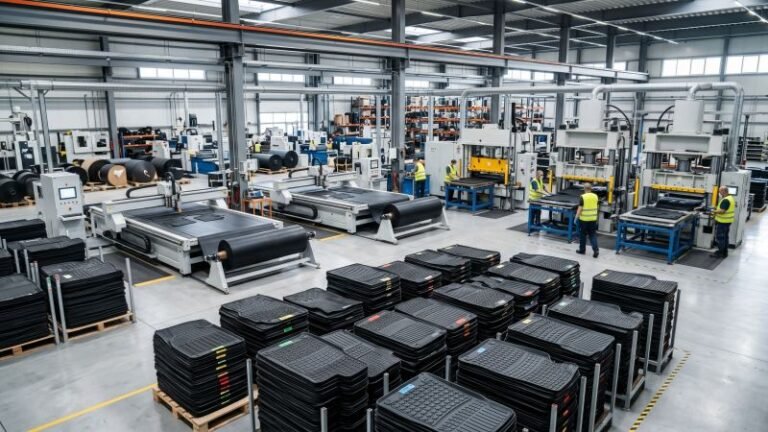
Injection molding is the gold standard for mass-producing heavy-duty “all-weather” mats found in auto shops. This process is ideal when you need to make thousands of identical mats quickly.
The workflow begins with raw material pellets, usually PVC or TPE. These pellets are fed into a heated barrel. Inside the barrel, a large reciprocating screw mixes and melts the material. Once the plastic becomes a liquid, the machine injects it under high pressure into a steel mold.
This process is similar to industrial die-casting used for engine blocks. The liquid material fills every cavity of the mold to form the mat’s shape, including the high ridges and deep channels designed to trap water.
Key Advantages:
- Speed: A typical cycle time can be as fast as 40 to 60 seconds per mat.
- Consistency: Every mat produced is identical to the last one.
- Waste Reduction: Excess material (sprues and runners) can often be reground and reused immediately.
However, the barrier to entry is high. The steel molds required for this process are expensive to machine. Therefore, injection molding is usually reserved for universal mats or very popular vehicle models where high sales volume justifies the initial tooling cost.
Compression Molding and Hot Pressing Techniques
For modern 3D custom-fit mats, especially those made from TPE sheets or XPE composites, compression molding (often combined with vacuum forming) is the preferred technology. Unlike injection molding, which melts pellets, this process starts with a pre-extruded solid sheet.
The Workflow:
- Heating: The flat material sheet is passed through an industrial oven until it becomes soft and pliable.
- Forming: The hot sheet is transferred to a mold.
- Pressing: A hydraulic press forces the sheet against the mold surface. In vacuum forming setups, suction pulls the sheet tight against the mold features.
- Cooling: The material cools rapidly against the metal mold, locking in the 3D shape.
This technique allows for the creation of deep “dish” shapes that cover the vertical walls of a car’s footwell. It is less demanding on the machinery than injection molding because the material is already a solid sheet, not a high-pressure liquid.
The 3D Scanning and Digital Modeling Workflow
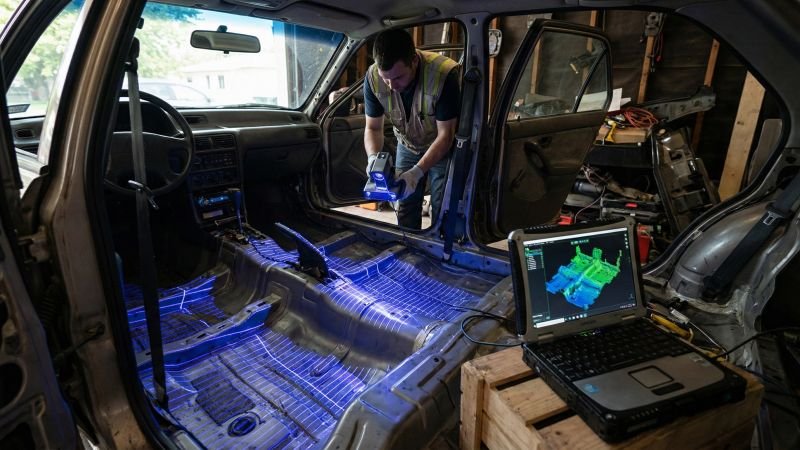
Before any physical manufacturing begins, engineers must capture the exact geometry of the vehicle’s floor. Traditional manual measuring is no longer sufficient for complex modern interiors.
Technicians use portable 3D laser scanners to create a digital map of the car’s footwell. The scanner projects laser lines onto the floor, recording millions of data points to form a “point cloud.”
From Scan to Mold:
- Scanning: The technician removes the car seats and scans the bare floor pan.
- Processing: Software cleans the “noise” from the scan data.
- Surfacing: Engineers use CAD (Computer-Aided Design) software to build a smooth digital surface over the point cloud.
- Mold Design: The final mat design, including patterns and logos, is created on top of this digital surface.
This digital workflow ensures the manufactured mat fits perfectly around seat tracks, gas pedals, and dead pedals. Accuracy is typically within 0.05mm to 0.1mm, ensuring no interference with vehicle operation.
Automated Cutting versus Die Cutting Methods
Once materials are formed or if producing flat carpet mats, they must be cut to the final shape. Two opposing methods dominate this stage:
Die Cutting (Press Cutting)
This is the traditional method for high-volume production. It functions similarly to sheet metal stamping used for vehicle body panels. A custom metal blade (the die) is bent into the shape of the mat. A hydraulic press stamps this die through the material. It is incredibly fast but lacks flexibility. If you change the car model, you must build a new physical die.
Automated Digital Cutting
This is the modern solution for custom orders. A computer-controlled table uses an oscillating knife (a blade that vibrates rapidly) to slice through the material. The machine follows the CAD file directly.
Comparison of Cutting Technologies
| Feature | Die Cutting | Automated Digital Cutting |
|---|---|---|
| Tooling Cost | High (Requires physical dies) | Zero (Digital files) |
| Setup Time | High (Changing dies) | Instant (Load file) |
| Speed | Very Fast (Seconds per cut) | Moderate (Minutes per cut) |
| Flexibility | Low | High (Any shape, anytime) |
| Best For | Mass Production (Universal mats) | Custom Fit / Just-In-Time |
High-Frequency Welding for Logos and Heel Pads
In luxury mat manufacturing, stitching is sometimes a weak point. Needle holes can allow water to leak through the mat, damaging the car’s carpet. To solve this, manufacturers use High-Frequency (HF) Welding.
HF welding does not use external heat sources. Instead, it uses high-frequency electromagnetic energy to excite the molecules within the material (typically PVC or TPU). This internal friction causes the material to melt and fuse together from the inside out.
Applications:
- Heel Pads: The reinforced pad under the driver’s heel is welded onto the main mat. This creates a watertight bond that is stronger than the material itself.
- Embossed Logos: HF welding can press a logo into the mat while simultaneously bonding a colored PVC piece, creating a crisp, permanent brand mark.
This process is critical for maintaining the waterproof integrity of TPE and PVC mats. It eliminates the need for thread, which can rot or fray over time in wet conditions.
Critical Machinery Checklist for Production Lines
A complete production line typically requires specific equipment to ensure compatibility with modern vehicle dimensions and maintain high production efficiency.
A complete production line typically requires five core categories of machinery: high-precision 3D laser scanners for data capture, oscillating knife digital cutters for material sizing, hydraulic vacuum forming machines or injection molders for shaping, heavy-duty industrial sewing machines for finishing, and extruders for creating raw material sheets. Selecting machines with the correct tonnage, cutting speed, and bed size is crucial for ensuring compatibility with modern vehicle dimensions and maintaining high production efficiency.
3D Laser Scanners for Precise Vehicle Data Acquisition
The first piece of hardware in the modern manufacturing chain is the portable 3D laser scanner. Unlike traditional measuring tapes, this device captures the complex geometry of a vehicle’s footwell. It creates a digital blueprint essential for designing custom-fit mats.
You should look for handheld scanners rather than stationary tripod scanners. Handheld units allow operators to reach under the dashboard and around seat rails easily. These devices project a grid of laser lines onto the surface and record the reflection to measure depth and curvature.
Key Technical Specifications to Consider:
- Volumetric Accuracy: Look for devices offering accuracy between 0.02mm and 0.05mm. High accuracy ensures the final mat does not obstruct the gas pedal.
- Scan Rate: Faster scanners capture over 1,000,000 points per second, reducing the time a technician needs to spend inside a customer’s car.
- Light Source: Blue laser lines are generally superior to red lasers when scanning black carpet or shiny plastic trim, which are common in car interiors.
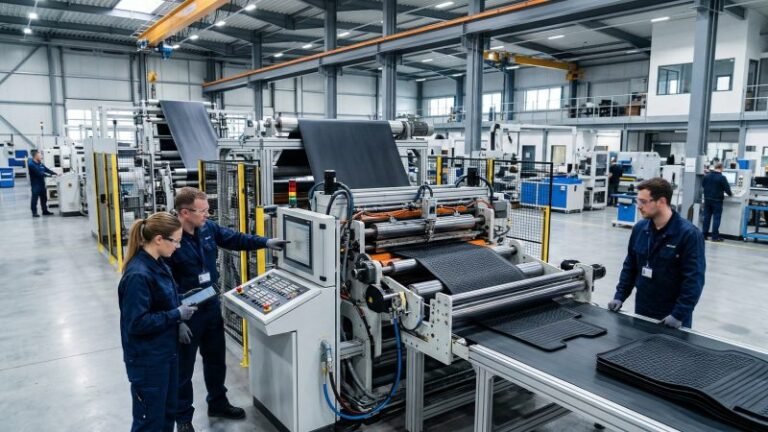
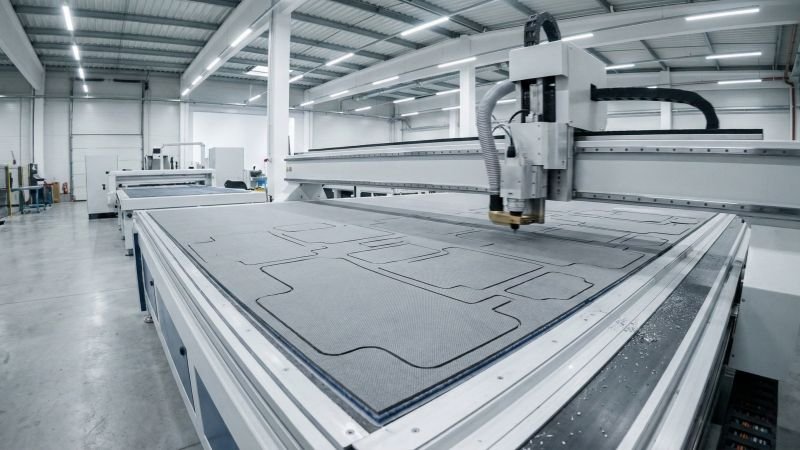
Oscillating Knife Digital Cutting Tables
Once you have your design and raw material sheets, you need to cut them. For TPE, XPE, and leather mats, an Oscillating Knife Cutting Machine is the industry standard.
Unlike laser cutters, which burn the edges of synthetic materials and leave a charred smell, an oscillating knife uses a physical blade. This blade vibrates up and down at high frequencies (thousands of times per minute) to slice through thick materials cleanly. It functions similarly to a high-speed jigsaw but with robotic precision.
Recommended Machine Parameters:
- Working Area: A table size of at least 1600mm x 2500mm is necessary. This accommodates the width of standard raw material rolls and allows you to cut a full set of mats (driver, passenger, and rear) in one run.
- Tool Heads: Ensure the machine head supports multiple tools. You will need a Pneumatic Oscillating Tool (POT) for thick foam and a Drag Knife for thinner vinyls.
- Vacuum Bed: The table must have a powerful vacuum pump (often 7.5kW or higher) to hold the material flat during cutting.
Hydraulic Vacuum Forming Machines for TPE Mats
For producing 3D “tray-style” mats using TPE or TPV sheets, the vacuum forming machine is the heart of the operation. This machine heats the plastic sheet and forces it over a mold.
These machines are distinct from standard packaging blister machines because they require much higher pressure and stronger heating elements to handle thick automotive grade sheets (typically 3mm to 6mm thick).
Critical Features:
- Double-Station vs. Single-Station: A double-station machine allows one operator to unload a finished mat while the machine forms the next one. This effectively doubles production output.
- Heating Elements: Ceramic or Quartz heaters are preferred for their consistent heat distribution. Uneven heating causes the mat to thin out in the corners, leading to weak spots.
- Hydraulic Pressure: While vacuum suction does the forming, hydraulic assists are often needed to press the mold frame down securely. Look for systems rated for sufficient clamping force to prevent air leaks during the forming cycle.
| Feature | Standard Blister Machine | Automotive Mat Forming Machine |
|---|---|---|
| Material Thickness | < 1.0mm | 2.5mm – 6.0mm |
| Heating Power | Low | High (Rapid penetration) |
| Mold Material | Wood/Resin | Aluminum (Water-cooled) |
| Cooling System | Air Fans | Industrial Chillers |
Heavy-Duty Industrial Sewing Machines and Edging Tables
Even for “rubber-like” TPE mats, sewing is often required to attach edge binding (the fabric border) or velcro clips. For luxury leather mats with diamond stitching, sewing machines are the primary production tool.
Standard garment sewing machines will fail here. The motor will burn out, or the needle will snap when trying to penetrate 10mm of multi-layer XPE foam and leather.
Required Machine Types:
- Compound Feed (Walking Foot) Machines: These machines feed the material from both the top and bottom. This prevents the layers of the mat from shifting or “bunching up” as you sew long straight lines.
- Computerized Pattern Sewers: For diamond or honeycomb stitching on luxury mats, automated machines are used. The operator clamps the material frame, and the machine automatically sews the complex geometric pattern based on a digital file.
- Long-Arm Machines: These provide extra throat space (the distance between the needle and the machine body), which is essential when maneuvering large, stiff floor mats.
Extruders for Producing Raw Material Sheets
Large-scale factories often integrate vertically by producing their own TPE or TPV sheets rather than buying them. An extruder melts raw plastic granules and pushes them through a flat die to create continuous rolls of sheet material.
Machine Components:
- The Screw and Barrel: For TPE, a single-screw extruder is common. The screw diameter (e.g., 100mm or 120mm) determines the output rate (kg per hour).
- T-Die: This flat nozzle shapes the melted plastic into a wide sheet. The width of this die must match your widest car mat mold (usually 1.2 to 1.5 meters).
- Three-Roll Calender: Immediately after the die, the hot sheet passes through three chilled rollers. These rollers determine the final thickness and surface texture of the sheet. Note: The cooling capacity of these rollers is critical; if they are not cold enough, the sheet will warp.
By bringing extrusion in-house, a manufacturer gains control over the material’s thickness and color consistency, reducing reliance on external suppliers.
Post-Processing and Quality Control Standards
Post-processing involves the critical finishing tasks and quality assurance protocols required to transform a raw cut shape into a safe, usable product for the consumer market.
Post-processing involves the critical finishing tasks of edge binding, trimming, and retention clip installation that transform a raw cut shape into a safe, usable product. Following these assembly steps, quality control standards must be rigorously applied through abrasion resistance testing and VOC (Volatile Organic Compounds) analysis to ensure the mats meet automotive durability and environmental safety requirements.
Edge Trimming and Binding Techniques
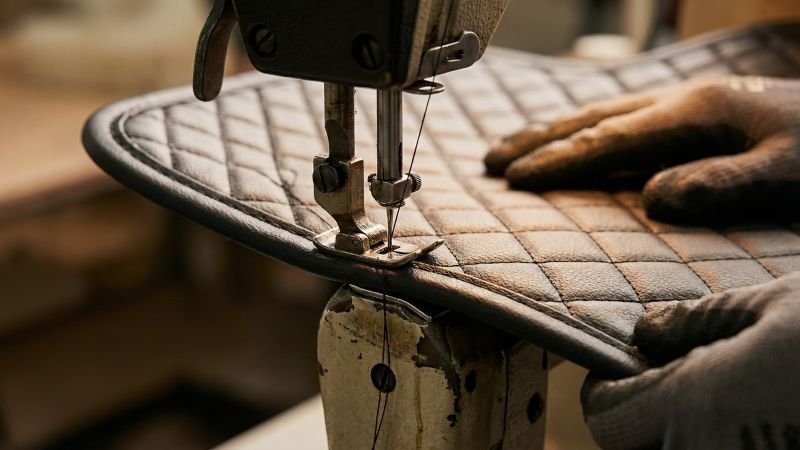
Once a mat is cut to the correct shape, the edges are often raw and unfinished. For multi-layer XPE or carpet mats, these exposed edges are aesthetically unappealing and prone to separation. Therefore, manufacturers must apply a finishing technique known as binding.
Binding involves wrapping the raw edge of the mat with a strip of material, typically nylon, polypropylene, or PVC leather. An operator feeds the mat through a sewing machine equipped with a specialized “binder attachment.” This metal guide folds the tape perfectly over the edge just before the needle stitches it down. This process is similar to applying piping to a car seat’s seams; it seals the core material and provides a finished, premium look.
Common Binding Styles:
- Ribbon Binding: A simple fabric tape used for standard carpet mats.
- Leatherette Binding: A strip of synthetic leather used for premium “5D” mats to match the surface texture.
- Overlocking (Serging): Instead of tape, a machine loops thick yarn over the edge. This is common on classic wire-loop or budget carpet mats.
Installation of Retention Clips and Anchors
The most critical safety feature of any car mat is the retention system. These are the plastic grommets or clips that lock the mat onto the vehicle’s floor anchors. If a mat slides forward, it can dangerously obstruct the brake or accelerator pedals.
The installation process follows two steps: Punching and Pressing. First, a die-cutter punches a clean hole through the finished mat at precise coordinates. Next, the worker inserts the top and bottom halves of the plastic clip.
For low-volume production, workers use a manual hand press to snap these clips together. However, high-volume lines utilize Pneumatic Press Machines. These machines use air pressure to snap the clips with consistent force, ensuring they do not separate during use. To learn more about the different types of fixings available, you can explore our range of car mat accessories and clips.
Types of Retention Systems:
- Hook Type: A simple hole reinforced by a ring.
- Twist-Lock (Oval/Round): A rotating clip that locks onto a post.
- Snap-Post: A press-stud mechanism.
Abrasion Resistance and Tensile Strength Testing
How long will a mat last under the driver’s heel? To answer this, Quality Control (QC) labs use the Taber Abrasion Test.
In this test, a sample of the mat material is placed on a rotating turntable. Two abrasive wheels are lowered onto the material with a specific weight load. As the table spins, the wheels grind against the surface. Technicians measure durability by counting how many cycles (rotations) it takes to wear through the top layer.
Typical Industry Benchmarks:
| Material Grade | Taber Test Requirement | Expected Lifespan |
|---|---|---|
| Economy PVC | ~500 Cycles | 1 Year |
| Standard Carpet | ~1,500 Cycles | 2-3 Years |
| Premium TPE | >3,000 Cycles | 5+ Years |
Additionally, Tensile Strength Testing is performed on the bottom layer. A machine pulls the material from both ends until it rips. This ensures that the anti-slip backing will not delaminate (peel off) when the user removes the mat for cleaning.
Odor Testing and VOC Compliance Checks
Modern consumers and automakers are extremely sensitive to chemical smells inside the cabin. Consequently, strict VOC (Volatile Organic Compound) testing is mandatory.
The standard procedure involves the “Bag Method” or a generic heat chamber test. A sample of the finished mat is placed inside a sealed, non-reactive bag or chamber. The chamber is then heated, typically to 65°C or 80°C, to simulate a car parked in the summer sun.
After a set period, the air inside the bag is analyzed. QC technicians check for distinct chemical families, such as Benzene or Formaldehyde. For a simpler factory-level check, a “Smell Test” is performed by trained inspectors who rate the odor on a scale from 1 (Odorless) to 5 (Unbearable).
- TPE Materials: Generally pass these tests easily as they are chemically stable.
- Rubber/PVC: Often require “degassing” periods or specific chemical additives to pass strict standards like REACH (European Union) or Prop 65 (California).
Setting Up Your Factory: Layout and Optimization
Setting up a manufacturing plant requires strategic layout planning and infrastructure assessment to optimize efficiency and profitability.
A well-optimized factory layout utilizes a linear, unidirectional workflow where raw materials enter at one end and finished goods exit at the other, minimizing material handling time. Operational success further depends on securing robust three-phase electrical infrastructure to support high-load heating elements, calculating ROI based on production volume versus labor costs, and selecting equipment suppliers who provide comprehensive after-sales training and accessible spare parts.
Workflow Layout for Material Flow Efficiency
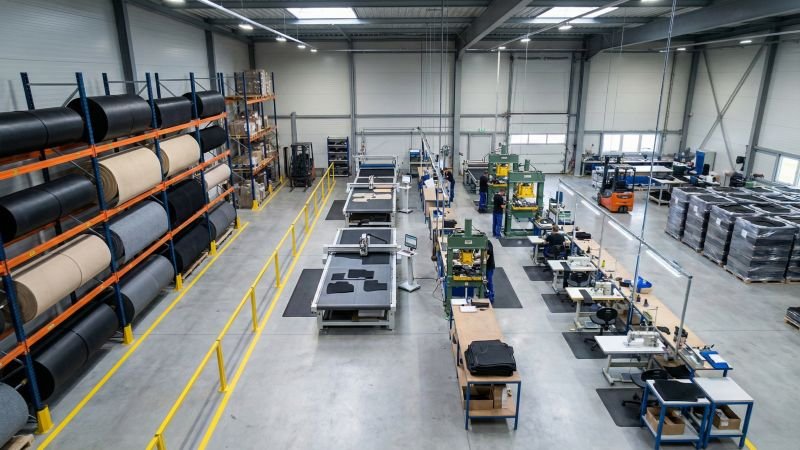
The physical arrangement of your machinery is just as important as the machines themselves. A poor layout causes “traffic jams” on the factory floor, where workers wait for materials or forklifts cross paths dangerously.
To maximize efficiency, you should implement a Linear (Unidirectional) Workflow. This means materials flow in one direction only: from Raw Material Storage to Cutting, then to Forming, followed by Sewing/Finishing, and finally to Packaging.
Key Zones to Plan:
- Buffer Zones: You must leave space between the cutting table and the sewing station. This area holds “Work in Process” (WIP) stacks. Without this, your sewers will run out of work if the cutter stops for maintenance.
- Waste Management Paths: Automated cutting generates significant scrap material. Design your aisles wide enough for waste bins to be removed without blocking the production line.
- Climate Control Areas: If you are storing TPE or leather rolls, humidity and heat can affect the material before it is even processed. Ensure your storage zone is climate-controlled to prevent warping.
Power Consumption and Infrastructure Requirements
Industrial car mat machinery requires substantial power infrastructure. Standard residential electricity is insufficient. You must ensure your facility is equipped with Industrial 3-Phase Power.
Critical Infrastructure Needs:
- Electrical Load:
- Heating: Vacuum forming machines consume the most power. A typical double-station machine may draw 30kW to 50kW just for the heating elements.
- Stability: Voltage fluctuations can ruin a batch of TPE mats during the heating cycle. Installing industrial voltage stabilizers is often necessary. Note: Electrical voltage standards (e.g., 220V, 380V, 480V) vary by country and machine motor specifications.
- Compressed Air Systems:
- Many machines, including oscillating knife cutters and pneumatic clip presses, rely on air pressure, not just electricity.
- You need a centralized Screw Air Compressor rather than small piston compressors. Piston compressors are often too loud and cannot provide the constant pressure (typically 0.6 – 0.8 MPa) required for continuous cutting operations. If the air pressure drops, the cutting knife may stall or cut incompletely.
Determining ROI: Automated Lines vs Manual Labor
When setting up your line, you face a major financial decision: should you invest in expensive automated machinery or rely on manual labor? This choice depends on your daily output targets.
For a startup producing fewer than 50 sets a day, manual labor (using hand cutters and simple presses) keeps initial debt low. However, as you scale, labor costs usually exceed the cost of automation.
Comparative Analysis: Manual vs. Automated Cutting
| Feature | Manual Cutting | Automated Oscillating Knife |
|---|---|---|
| Initial Investment | Very Low ($2k – $5k) | High ($20k – $50k) |
| Material Waste | High (Human error/spacing) | Low (Computer nesting) |
| Daily Output (8 hrs) | ~20 – 30 Sets | ~100 – 150 Sets |
| Consistency | Variable | 100% Identical |
| Labor Requirement | Skilled Craftsmen | Machine Operator |
If your target is the “Universal Mat” market (selling to supermarkets), you must automate immediately to lower the unit cost. If you are a “Boutique Shop” making custom leather mats for luxury cars, manual craftsmanship can be a selling point, though it limits your scalability.
Criteria for Selecting Reliable Equipment Suppliers
Buying industrial machinery is a long-term strategic partnership, not a one-off transaction. A machine that is cheap to buy but impossible to fix will bankrupt your factory.
Selection Checklist:
- Local Support or Virtual Training: Can the supplier send an engineer to install the machine? If not, do they offer detailed video call support? Complex machines like the 3D Laser Scanner require software training. Without proper instruction, the hardware is useless.
- Non-Proprietary Components: Check the electrical cabinet. Does the machine use standard parts like Schneider electrics, Omron relays, or Panasonic servos? If a relay fails, you want to be able to buy a replacement at your local hardware supplier, rather than waiting weeks for a custom part to ship from overseas.
- Sample Testing: Before purchasing a vacuum former or cutter, send your specific raw material to the supplier. Ask them to film a video of their machine processing your material. This proves the machine can handle the specific density and thickness of the foam or rubber you intend to use. For assistance with machine verification or specific requirements, please feel free to contact our support team.
Conclusion
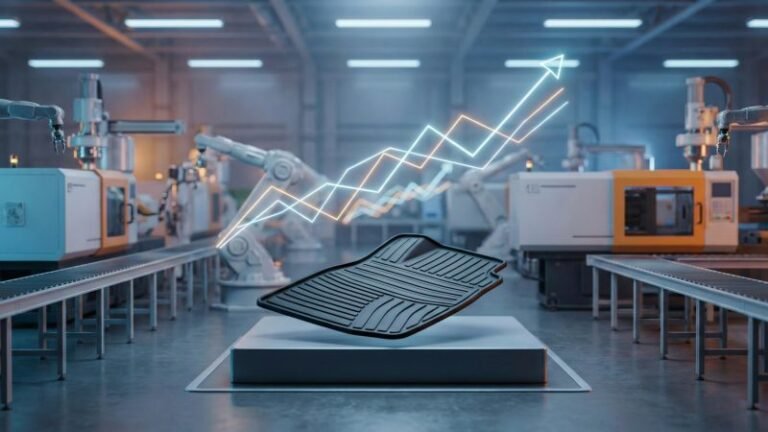
Manufacturing high-quality car mats is a complex interplay of engineering, material science, and strategic equipment selection. Success in this industry is not achieved by simply purchasing the most expensive machinery, but by understanding how materials like TPE, XPE, and PVC interact with injection molding or vacuum forming processes. By investing in precise technologies like 3D scanning and automated cutting, and adhering to strict quality control standards for VOCs and durability, manufacturers can produce floor mats that meet the rigorous demands of the modern automotive market. Whether you are establishing a mass-production facility or a boutique custom shop, a well-planned workflow and reliable supply chain are the foundations of a profitable operation.